Event discussed financing initiatives for policies capable of promoting sustainable development
Brasília, Brazil, July 7, 2025 – The Sustainable School Feeding Network (RAES) showcased its experience at the 4th International Conference on Financing for Development, promoted by the United Nations (UN) and held in Seville, Spain, from June 30 to July 3, 2025.
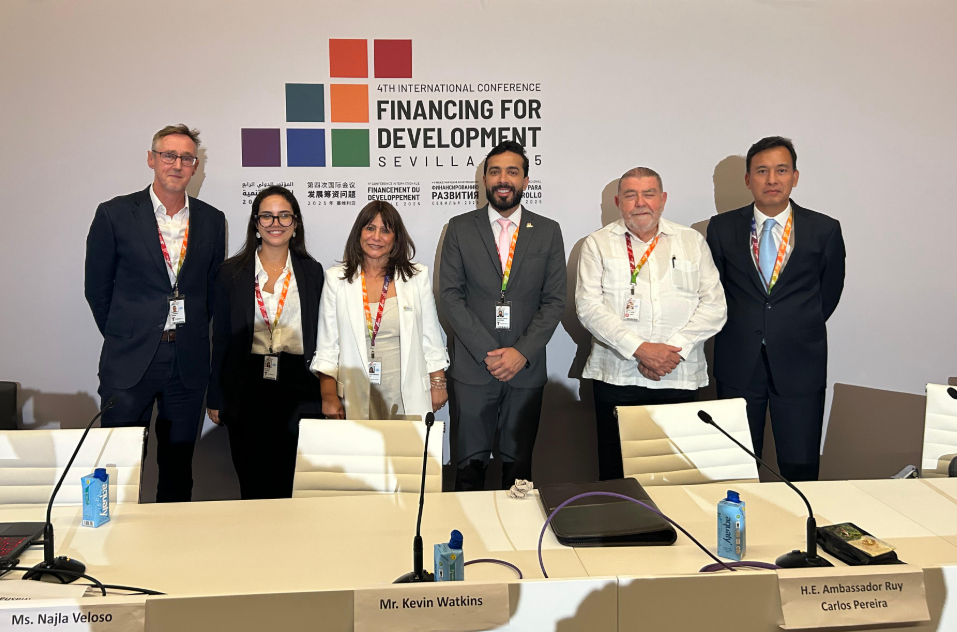
The side event “Financing school feeding as a cornerstone for ending hunger, building resilience and fostering development” was part of the Conference programme and was organized by the Brazilian Government through the Brazilian Cooperation Agency (ABC), the National Fund for Educational Development (FNDE) and the World Food Programme (WFP) Centre of Excellence against Hunger.
RAES is a trilateral South–South cooperation initiative jointly executed by ABC and FNDE and with the executive secretariat by the Food and Agriculture Organization of the United Nations (FAO).
At the event, RAES’s role in connecting 18 countries of Latin America and the Caribbean (LAC) to strengthen school feeding programmes (SFPs) was highlighted, as was the joint construction of an agenda with those countries covering priorities such as expanding student coverage, improving school infrastructure, developing standards, strengthening links with family farming, implementing food and nutrition education actions and increasing budgets for these programmes, all based on the human right to adequate food.
Prioritizing school feeding
ABC Director, Ambassador Ruy Pereira, underscored three key initiatives supported by Brazil on the global food-security agenda: the Global Alliance against Hunger and Poverty, created under the Brazilian G20 presidency and taking school feeding as a reference policy; the School Meals Coalition, chaired by Brazil, Finland and France, which now brings together 109 countries and more than 140 partners and whose second summit will be held in September 2025 in Fortaleza; and the Sustainable School Feeding Network (RAES), for its work with 18 countries in the LAC region.
Pereira stressed the importance of the declaration by RAES member countries committing to a joint regional agenda for priority SFP themes. “Financing is the first priority. The Brazilian Government’s view is that RAES has contributed and will continue to contribute decisively to achieving the Coalition’s goal: that all children receive healthy school meals by 2030.”
Kevin Watkins of the School Meals Coalition presented part of an ongoing study and initial data, showing the importance of adequate budgetary provisions. He reiterated the need for an intersectoral approach and greater political commitment to secure sustainable financing for school feeding policies.
Najla Veloso, from RAES’s Executive Secretariat, highlighted the network’s and member countries’ efforts to strengthen school feeding programmes in the region. She pointed to collectivity as key to programme quality and noted that the network has fostered firm, sustained political commitment from member-state governments.
Veloso explained that investment in national development and the guarantee of the human right to food are commitments adopted by the countries. Finally, she said RAES’s presence at the event helps bring countries together around topics of shared interest, such as expanding SFP financing.
Success stories
Tri Purnajaya, Director of Economic Development and Environment at Indonesia’s Ministry of Foreign Affairs, shared the country’s plans to increase investments in school feeding and sustainable diets, taking into account nutrition, food security and public procurement, as well as the importance of pilot projects. Purnajaya expressed interest in strengthening international partnerships, including innovative financing mechanisms and knowledge-sharing platforms.
Anderson Sampaio Santos, Director of Educational Actions at FNDE, presented the legal and institutional structure of Brazil’s National School Feeding Programme (PNAE), considered an international benchmark for reach, sustainability and social impact, serving 40 million students daily. Santos noted that 30 per cent of the PNAE budget must be spent on food from family farming, which bolsters local agrifood systems and promotes rural development. He also showed the percentage increase in municipal purchases in the last years.
In her remarks, Najla Veloso also discussed Paraguay’s Zero Hunger in Schools Programme. Created by Law 7.264/2024, the programme established the National School Feeding Fund (FONAE), ensuring stable financing and universal, equitable coverage of school meals. Paraguay also set up a National School Feeding Council (CONAE), chaired by the Office of the Chief of Staff to the Presidency and composed of the ministries of Social Development; Education and Sciences; Economy and Finance; and Social Development, alongside the Paraguayan Organization for Intermunicipal Cooperation (OPACI) and the Council of Governors, which oversee FONAE resources.
The session also featured a virtual contribution from Ana Carolina Baez, Director of Health and Nutrition at the Dominican Republic’s National Institute for Student Welfare (INABIE). Baez said the programme’s budget had nearly tripled over the past decade. Among the advances, she cited adding fresh fruit to menus, eliminating nectars and reducing sugars, salt and fat in meals. She also emphasised the broader coverage: the service now reaches more students and more schools. “One solution enabling these advances was exchanging experiences with other countries and dialogues facilitated by RAES. Through various missions and exchanges promoted by the RAES Network, we brought decision-makers closer to field experiences. That direct exposure was key to raising awareness and enabled concrete improvements in our programme.”
Ilza Amado Vaz, Minister of Foreign Affairs of São Tomé and Príncipe, also took part actively in the session and discussed her country’s SFP, regarded as a benchmark in West Africa. She highlighted national political support and long-term-financing challenges, stressing the need for environmentally responsible solutions such as clean technologies for cooking school meals.