Dialogue on FNE brought together more than 450 professionals from the country and took place as part of the celebrations for World Food Day in Paraguay
October 6, 2025, Asunción, Paraguay – The Sustainable School Feeding Network (RAES) participated on October 3 in the event “Relevance of Food and Nutrition Education (FNE) in public policies”, which is part of a series of virtual talks promoted by the Ministry of Education and Sciences (MEC) of Paraguay within the framework of the National Guideline on Food and Nutrition Education, in support of the School Feeding Programme – Zero Hunger. The activity took place as part of the World Food Day celebrations in the country.
The series of talks is supported by RAES, the Food and Agriculture Organization of the United Nations (FAO), and the United Nations Children’s Fund (UNICEF).
The meeting was a space for learning and dialogue that brought together 455 participants from Paraguay, including teachers, principals, education supervisors, student teachers, health professionals, representatives from provincial governments, ministries, the productive sector, and academia — representing collaborative work among all actors: education, health, agriculture, social development, the productive sector, and educational communities.
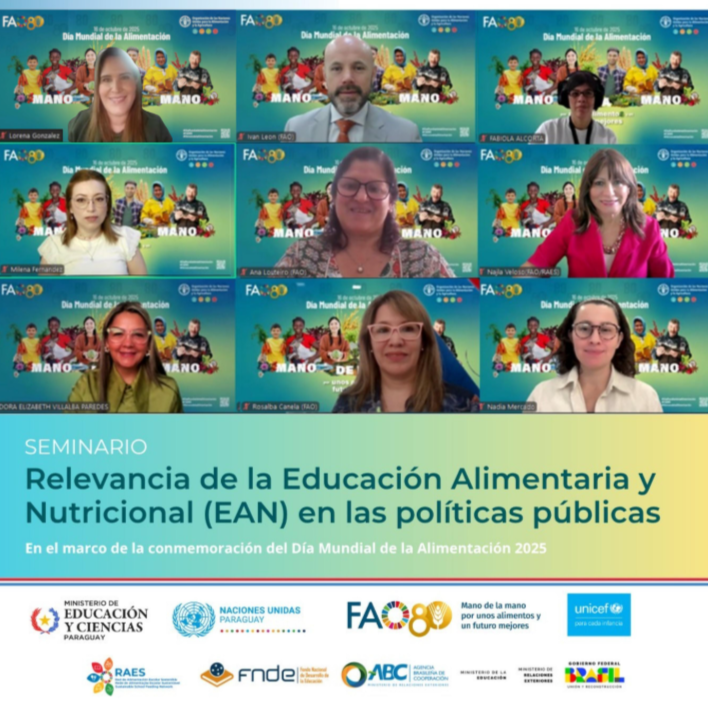
The seminar is part of the Ministry of Education (MEC) major challenge to develop and promote Food and Nutrition Education in all educational institutions in the country, with the effective implementation of the School Feeding Programme – Zero Hunger. In this sense, the meeting sought to foster spaces for discussion and analysis among different educational and non-educational actors on the development and promotion of FNE in support of this national programme.
The Executive Secretary of RAES and FAO School Feeding Specialist in LAC, Najla Veloso, addressed the importance of Food and Nutrition Education in public policies. She highlighted that schools are key spaces to promote health and food, as students spend a large part of their day in them. “Based on the learning of professionals, experiences and content on nutrition and the environment can be incorporated into local school feeding programmes. These interventions, in the short, medium, and long term, have an impact on school feeding policy, education, health, and others. In addition, healthy food environments directly contribute to guaranteeing the Human Right to Adequate Food,” she added.
The opening session was attended by the Director General of Student Welfare of the Ministry of Education, Lorena González, and the FAO Representative in Paraguay, Iván Felipe León Ayala. The Director of School Feeding of the Ministry of Education, Andrea Milena Fernández, highlighted the background of FNE in Paraguay and the national guideline on this topic in support of the School Feeding Programme Zero Hunger.
The series of talks will continue on October 24, with the topic “Food and Nutrition Education in the school context for Latin America and the Caribbean”, and on November 7, with discussions on school gardens as an educational component.
Context of school feeding in Paraguay
The National Constitution of Paraguay recognizes the right to adequate food, and since its promulgation in 1992, there has been progress in implementing this right in the country. In this context, significant normative, institutional, and political advances have been achieved in different sectors linked to the right to food.
Among the most significant is that in 2013, a multidisciplinary team advised by FAO began work on a proposal for a radical transformation of school feeding in Paraguay, centered on the student and with a strong component called Food and Nutrition Education, focused on the teaching and learning process.
Law No. 5210/14: In 2014, Law No. 5210/14 on School Feeding and Health Control was enacted, through which school feeding shifted from an assistential approach to one based on the right to food for students during their time in educational institutions. It mandates the provision of fresh, varied, and adequate food according to students’ nutritional needs and prioritizes products from family farming, with the goal of improving access, reducing absenteeism, and increasing school retention, while promoting healthy eating habits and lifestyles among students.
Law No. 5210/14: This law ensures compliance with the right to food and several of the Millennium Development Goals as a local development strategy, primarily to ensure the incorporation of FNE and to frame school feeding within the strategic line of guaranteeing educational quality, as a public policy to be implemented in the educational sphere to ensure student well-being during attendance at educational institutions. This paradigm shift, where the student and the learning process become the central focus, authorizes the Ministry of Education to include FNE in the teaching and learning process.
Law No. 7264/24: In April 2024, Law No. 7264 was enacted, creating the National School Feeding Fund for the equitable universalization of school feeding Zero Hunger in schools and the educational system. This law modifies and expands Law No. 5210/2014 on “School Feeding and Health Control” and its subsequent amendments, assigning the Ministry of Social Development (MDS) the leadership of school feeding in Paraguay within this regulatory framework.
Decree No. 1584/2024: This decree regulates Law No. 7264/2024. Its Article 13, paragraph e) stipulates that the food and nutrition education guidelines must be defined by the Ministry of Education. In other words, the responsibility for maintaining the educational focus of the School Feeding Programme in the country lies with the Ministry of Education.
Therefore, considering the aforementioned regulatory frameworks, the major challenge is to develop and promote Food and Nutrition Education in all educational institutions nationwide, in support of the School Feeding Programme – Zero Hunger (PAE-H0).
Consequently, the Ministry of Education issued Ministerial Resolution No. 2019, dated December 19, 2024, which approves the National Guideline on Food and Nutrition Education in support of the School Feeding Programme Zero Hunger (PAE-H0).
The provisions indicated in this document are addressed to the different educational actors, describing the directives and general guidelines for the implementation process of Food and Nutrition Education in educational institutions in Paraguay, as well as the different activities and tasks to be carried out at the central, departmental, zonal, and local levels, in accordance with the current legal framework on school feeding in the country.
Content produced by FAO and adapted by RAES team.