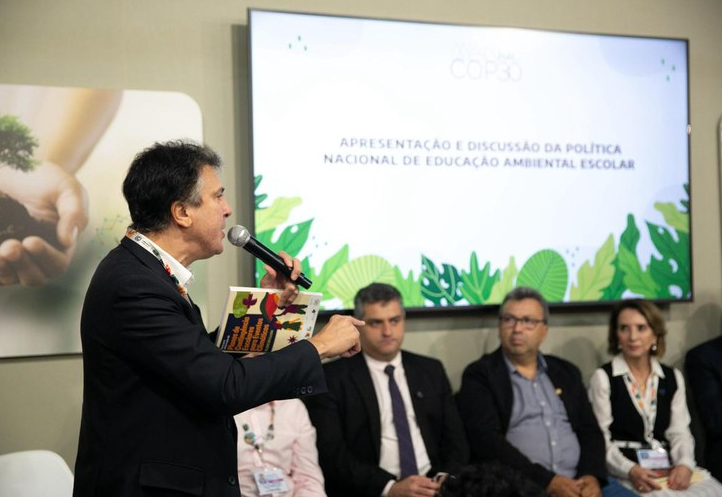
The Ministry presented the policy during a panel that marked the beginning of its participation in the conference in Belém.
Belém, Pará, 12 November 2025 – To present and discuss the National Policy for Environmental Education in Schools (Pneae), the Minister of Education, Camilo Santana, and the Secretary for Continuing Education, Youth and Adult Literacy, Diversity and Inclusion (Secadi) of the Ministry of Education (MEC), Zara Figueiredo, participated on 12 November in a panel of the 30th United Nations Climate Change Conference (COP30), in Belém, Pará.
On the occasion, Santana emphasized that education is integrated into the environmental agenda for the future of the planet and plays a strategic role in global climate action. “Our schools, universities and federal institutes are fertile ground for cultivating climate awareness and sustainability. The future lies in our youth,” he said.
The minister noted that all public policies of the MEC are developed in partnership with Brazilian states and municipalities, including the development of the Pneae, which will soon be launched by the Ministry. “Thinking about environmental issues fundamentally involves education. When we talk about education and its relationship with the environment, we are talking about quality education, in which everyone has access and remains in school. But we want education with equity and inclusion, and the climate issue is no longer a matter of the future—it is a matter of the present, the result of the extreme events Brazil has been experiencing.”
The climatic events that have occurred in Brazil and around the world—such as global warming, floods, and tornadoes—were also recalled by the minister as consequences of human actions on the environment. “Almost 1,500 municipalities were affected by school closures in 2024 due to extreme weather events in Brazil. We are talking about more than 10,000 schools and more than 2.5 million students affected by the interruption of classes. This also impacts school performance,” he stated.
Panel and the Pneae
During the panel, Secretary Zara Figueiredo presented the details of the Pneae, which aims to strengthen the institutional capacities and pedagogical practices of school networks so they can be sustainable and able to prevent, adapt to, and recover from crises, emergencies, and climate-related environmental risks.
“What we are doing here is bringing environmental education into educational policy and thereby influencing the National Education Plan (PNE), so that it gains the status of a State policy,” she said.
Figueiredo highlighted that the climate crisis affects basic education and that 1,941 Brazilian municipalities face a high risk of landslides, flash floods, and inundations. “These climate events affect the poorest students and those from traditional populations. Students from the poorest municipalities may lose up to half a year of learning due to rising temperatures, and 35% of schools located in the hottest areas have a majority of black students. Although these populations contribute least to climate impacts, they are the ones who suffer the most,” she noted.
Data from the 2024 Brazilian School Census show the effects of climate events on schools. According to the statistics, 6.7% (10,541) of schools and nearly 6.1% (2.51 million) of enrollments were affected by school closures in 2024 due to extreme climate events. In addition, according to 2024 data from the World Bank, students in poorer municipalities can lose up to half a year of learning because of rising temperatures.
The 2024 School Census also showed how Brazilian schools are preparing to deal with climate change, whether in terms of physical infrastructure or teacher training:
Infrastructure
- 79% of public schools have waste collection.
- 64.8% of public schools have green areas.
- 40% of public schools have climate-controlled classrooms.
Pedagogical aspects related to environmental education
- 60.3% of public schools state that environmental education is a cross-cutting axis in the curriculum.
- 67.3% of public schools carry out environmental education activities.
The discussion featured the participation of the Minister of Agrarian Development and Family Farming, Paulo Teixeira; the Acting President of the Amazonian Universities Association (Unamaz), José Seixas Lourenço; the Secretary of Education of Pará, Ricardo Sefer; the Secretary of Education of Rio Grande do Sul, Raquel, representing the National Council of State Education Secretaries (Consed); the President of the National Union of Municipal Education Directors (Undime), Luiz Miguel Martins; and the President of the Education Sector Chamber of the Legal Amazon Consortium, Sandra Cassimiro.
Pneae
The National Policy for Environmental Education in Schools consolidates an innovative and specific public policy to support schools and educational networks, acting in a cross-cutting manner by integrating education, environment and climate within the school setting. It strengthens federative cooperation, professional training, and the construction and expansion of resilience within school systems, aligned with national climate-adaptation goals and the UN 2030 Agenda (SDGs 4, 13 and 18), with particular focus on climate justice and support for municipalities, territories and schools facing greater climate and socio-environmental vulnerability, while valuing and integrating scientific, traditional and local knowledge.
Although environmental education is a cross-cutting theme and is connected to actions and practices developed in non-formal spaces—such as selective waste collection, recyclers’ initiatives, and reforestation practices—there is a dimension of environmental education that must be strengthened, funded, and monitored by educational policies within school networks.
In this regard, the MEC designed the Pneae around the following pillars:
Knowledge sharing and practices: creation of the Chico Mendes Seal for Environmental Education in Schools (recognition of sustainable schools and school networks); Climate Action Day for educational mobilization around climate justice; public calls to support sustainable educational practices led by youth; and communication efforts focused on promoting traditional knowledge.
Federative coordination: with a tripartite governance structure involving MEC, Consed and Undime, and an Executive Governance Network with 53 state, municipal and Federal District agents, as well as 346 territorial agents for environmental education in schools;
Protocols, guidelines and guiding materials: including Resilience Plans for school networks and individual schools;
Training: curriculum and pedagogical practices for sustainable and resilient schools, adaptation and response to climate challenges, with emphasis on nature-based solutions and traditional and local knowledge, green schoolyards and bioconstruction;