Created 70 years ago, the programme guarantees more than 50 million meals a day for nearly 40 million students in the Brazilian public school system, in around 150,000 schools across the country.
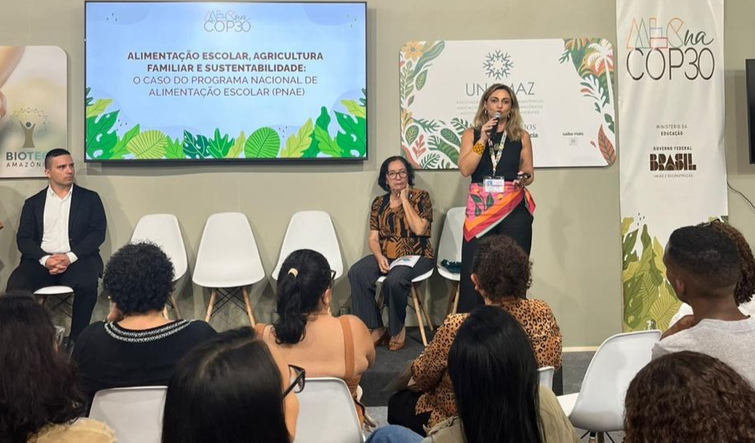
Belém, Pará, 12 November 2025 – In the debate on ‘School feeding, family farming and sustainability’ held at the 30th United Nations Climate Change Conference (COP30) on 12 November in Belém, state of Pará, Brazil’s Ministry of Education (MEC) presented the National School Feeding Programme (PNAE). Created 70 years ago, the programme guarantees more than 50 million meals every day for nearly 40 million students in public primary and secondary education, in around 150,000 schools throughout Brazil.
“School feeding policy is closely linked to the environment and family farming. It reaches small producers, fishermen and riverside communities, who supply their produce to school feeding programmes,” said Education Minister Camilo Santana.
Representing the MEC and the National Education Development Fund (FNDE) on the panel, PNAE general coordinator Karine Santos celebrated the results of the public policy. “Of all the resources invested in school feeding, at least 30% must be allocated to family farming. As of 1 January 2026, this will rise to 45%. This change in the percentage allocated to family farming is transforming the agri-food systems in our cities and territories; it is changing what we want to offer our students; it is changing the quality of the menu in every public school in Brazil,” she said.
Translated with DeepL.com (free version)
The Minister of Agrarian Development and Family Farming, Paulo Teixeira, drew attention to the objective of the debate, which should focus on the country’s food sovereignty. According to him, it is essential to feed people with quality, healthy food.
“In Brazil, we have two types of problems: those who do not have enough to eat, for whom President Lula is implementing a major programme and has removed Brazil from the Hunger Map; and those who eat poorly, who have abandoned the foods of our people’s food culture and have switched to consuming ultra-processed and sugary foods. This has led to serious health problems, such as diabetes, hypertension and obesity, which are sensitive issues for Brazilian society,” Teixeira emphasised.
Also participating in the discussions were Ivanira Amaral Dias, professor at the Faculty of Nutrition and the Postgraduate Programme in Nutrition in the Amazon at the Federal University of Pará (UFPA); Carmen Lúcia Brandão, nutritionist, president of the School Food Council of the State of Pará and member of the Municipal Council for Food and Nutritional Security of Belém; and Reinaldo Gregoldo, External Control Auditor of the Court of Auditors of the Municipalities of the State of Pará.
The panel also highlighted good practices developed in Pará and other regions of Brazil that link public procurement for school feeding with food and nutrition education, promoting local foods and the food culture of communities.
By participating in COP30, FNDE reaffirmed its commitment to transformative and sustainable education, demonstrating that public policies can go beyond the classroom — promoting inclusion, quality of life, and environmental awareness for millions of Brazilian families.
Content produced by the Brazilian Ministry of Education and the FNDE