
Event brought together leaders from across Brazil and highlighted progress, challenges, and the need to strengthen technical assistance, rural extension, agricultural research, and land regularization entities.
Brasília, Brazil, 25 November 2025 – The Sustainable School Feeding Network (RAES) participated on 25 November, in the 68th Ordinary General Assembly of the Brazilian Association of Technical Assistance, Rural Extension, Agricultural Research and Land Regularization Entities (Asbraer). The event brought together leaders from Asbraer’s member entities from across Brazil, as well as representatives from state and federal governments.
The assembly was organized by Asbraer in partnership with Emater-Rio, the Fisheries Institute Foundation of the State of Rio de Janeiro (Fiperj), and the Subsecretariat for Regional Development of the Interior, Fisheries and Family Farming (SEDIPAF), with support from the Secretariat of Agriculture, Fisheries, Livestock and Supply of Rio de Janeiro (SEAPPA) and the state’s Agricultural Research Company (Pesagro-Rio).
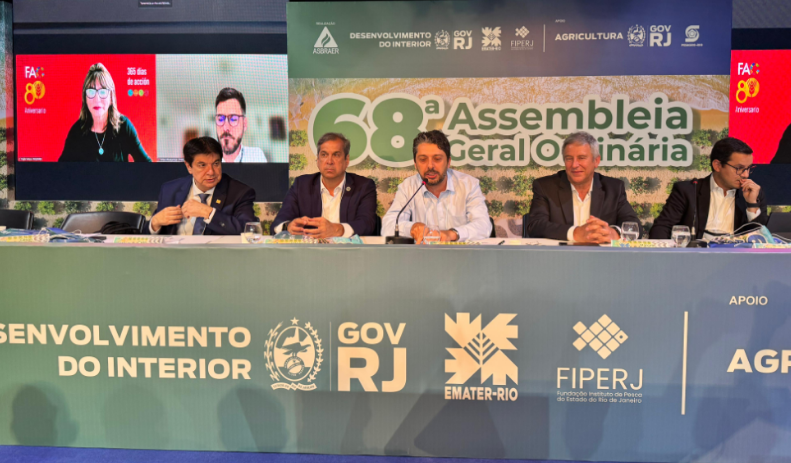
Paola Barbieri, project analyst at the Brazilian Cooperation Agency (ABC), stated that technical assistance is always a key topic in international cooperation. She explained the school feeding cooperation that began in 2009 and highlighted how this work has strengthened school feeding in the region, culminating in the creation of RAES in 2018, which now includes 18 member countries in Latin America and the Caribbean.
Felipe Albuquerque, specialist in financing and implementing educational programs and projects at FNDE, said that technical assistance is essential for the proper functioning of the National School Feeding Programme (PNAE). He noted that the programme involves around 40,000 family farmers and underscored the importance of intersectoral action. Albuquerque also highlighted that, starting in 2026, there will be a significant change: 45% of FNDE’s food procurement resources will be directed to family farming, increasing the current 30%.
Najla Veloso, school feeding specialist at the Food and Agriculture Organization of the United Nations (FAO) and executive secretary of RAES, commented that RAES works to promote continuous and permanent dialogue to strengthen school feeding at the regional level. She emphasized the development of the RAES regional agenda and its priorities together with the countries, and added that the technical assistance network — such as Brazil’s — is a very important element but not always present in all countries. “It is essential work and needs to be valued. In this cooperation strategy, all elements are important, and we cannot fail to recognize the value of technical assistance.”
Asbraer’s president, Otávio Maia, highlighted that public technical assistance entities are present in more than 90% of Brazilian municipalities and serve over 2 million farmers. “If today we have success in the country’s agriculture and livestock sectors, it is because there is ongoing work in technical assistance and rural extension, agricultural research and land regularization,” he concluded.