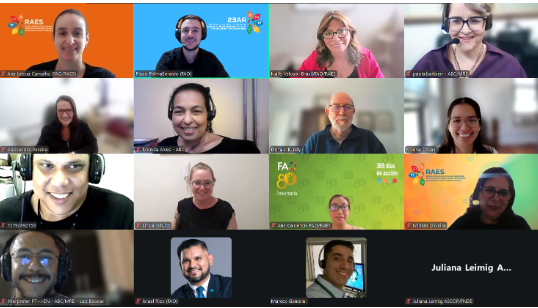
Brasília, Brazil, June 3, 2026 – The Sustainable School Feeding Network (RAES) held a meeting on Wednesday, June 3, with representatives of the Research Consortium for School Health and Nutrition, the Inter-American Development Bank (IDB), and the School Feeding Researchers Network (Rede PAE), led by UNIRIO.
RAES is a trilateral South-South cooperation initiative on school feeding promoted by the Government of Brazil through the Brazilian Cooperation Agency of the Ministry of Foreign Affairs (ABC/MRE) and the National Fund for Educational Development of the Ministry of Education (FNDE/MEC), together with member countries across the region. Its Executive Secretariat is coordinated by the Food and Agriculture Organization of the United Nations (FAO).
The initiative is part of the Network’s efforts to foster dialogue among different sectors and strengthen the implementation of the RAES Regional Agenda, a document developed by member countries that outlines priority actions to consolidate and expand school feeding programmes across the region.
The meeting aimed to discuss strategies to strengthen the regional school feeding agenda in Latin America and the Caribbean and explore opportunities for joint action.
During the meeting, participants discussed measures to enhance collaboration among RAES, the Research Consortium, international organizations, funding institutions, research centers, and governments in order to strengthen knowledge generation and develop joint initiatives aimed at improving the implementation of school feeding policies. Particular emphasis was placed on the important contribution of the academic sector to strengthening the governance of this public policy.
During the virtual meeting, participants highlighted the importance of generating evidence to support the implementation of school feeding programmes and inform decision-making by policymakers and governments. They also discussed the need to continue improving these programmes, which currently reach around 80 million students across LAC, based on the principle of the human right to food. Participants further emphasized the major challenge of expanding coverage to reach the approximately 170 million students in the region.
Participants also agreed that LAC has inspiring experiences and successful school feeding initiatives that deserve greater visibility and should be more widely shared with other countries.