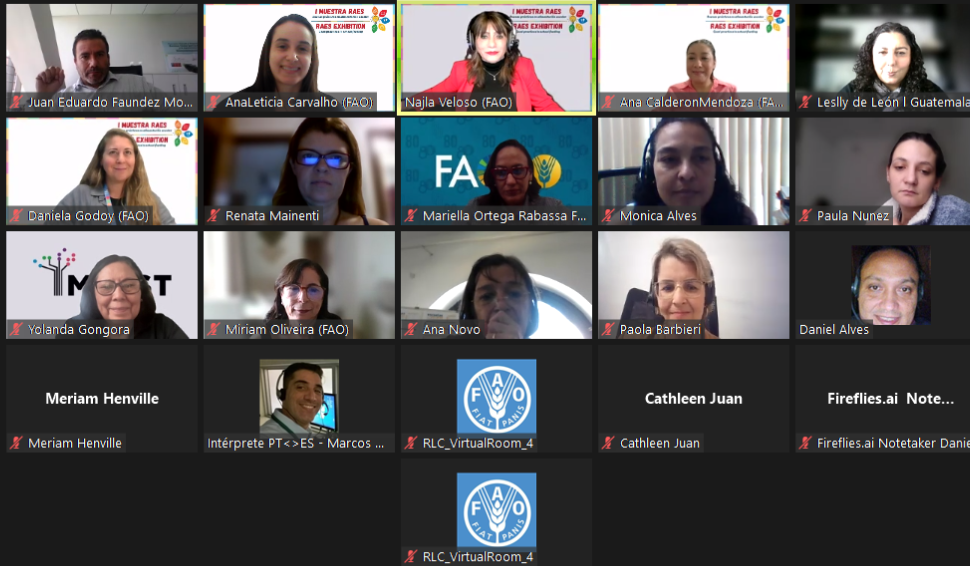
During the event promoted by FAO, the Government of Brazil and RAES, 11 countries from Latin America and the Caribbean presented solutions that integrate technology, food and nutrition education, sustainability and community participation to strengthen school feeding programmes; see the video below
Paulo Beraldo and Palova Brito
15 December 2025, Brasília, Brazil – The first edition of the RAES Exhibition of Good Practices in School Feeding brought together around 300 professionals from 20 countries in Latin America, the Caribbean and Europe to learn about successful initiatives strengthening school feeding programmes in the region. The virtual event aimed to promote exchange among countries and highlight initiatives linking school feeding and sustainable agrifood systems. The full video of the event will be available on the RAES platform.
RAES is jointly implemented by the Brazilian Cooperation Agency of the Ministry of Foreign Affairs (ABC/MRE) and the National Fund for Educational Development (FNDE/MEC), with the executive secretariat led by the Food and Agriculture Organization of the United Nations (FAO). Currently, 18 countries from Latin America and the Caribbean are part of the network.
Innovations and lessons learned towards sustainable school feeding
During the exhibition, experiences from 11 countries in the region were presented, strengthening the quality, community participation and sustainability of school feeding. In Chile, the App PAE was highlighted — a pilot tool that allows schools to upload images of the meals served alongside the planned menu. Families can view this information and provide feedback, strengthening programme transparency and community participation.
Brazil presented the Food and Nutrition Education Journeys (EAN), implemented since 2017, which promote the implementation of food education actions in schools. More than 11,000 educational institutions have already participated in innovative initiatives that foster healthy habits among students across the country.
In Belize, the training of programme cooks with the support of professional chefs helped improve the offer of healthy menus. The experience, which began in six schools, now reaches 78 educational centres and benefits 15,000 students. With this action, tastier meals are offered to students.
From Paraguay, the Mbo’Eco initiative showed how responsible waste management and environmental education can be integrated into school life, promoting greater awareness and commitment to sustainability among students, changing “the face of the school” into a clean and pleasant space, as confirmed by a Paraguayan teacher.
Suriname highlighted the value of international cooperation to expand access to training, technical exchanges and institutional support. It showed that, with the support of other countries, reality can be changed more quickly and efficiently. The Dominican Republic presented the Optiwaste initiative, a tool that allows schools to measure food waste and thus improve service efficiency and quality. The tool is an action to address environmental problems in schools and is implemented with the support of FAO in the country.
Saint Lucia shared the experience of a school with 100 students that integrates food produced in the school garden and promotes entrepreneurship among students with special needs. Along the same lines, Cuba presented a food and nutrition education project focused on youth learning, emphasizing student leadership, while Guatemala highlighted the role of school gardens as a tool that, in addition to being educational, promotes healthier diets. The three countries demonstrated school gardens as a pedagogical strategy that impacts several areas, especially education quality.
In Uruguay, School 75 presented its LAB Chef 75 initiative, which transformed the school routine into a space for shared innovation. The project achieved a 22% reduction in absenteeism in the control group through activities involving students and families in topics related to healthy eating, food handling and hygiene. Colombia closed the Exhibition by highlighting the importance of adapting school feeding to the realities of Indigenous communities, with respect for territorial, cultural and gastronomic differences. It reaffirmed that this requires dialogue, shared responsibility and joint organization with communities to ensure a relevant service that respects their identity.
The importance of sharing good practices
From the Government of Brazil, Paola Barbieri, Project Analyst at ABC/MRE, highlighted the role of international cooperation in promoting knowledge exchange and the dissemination of good practices that can be adapted and replicated in other countries. “May each practice presented at the exhibition serve as a seed for new initiatives in our countries. These exchanges transform cooperation into action.”
Daniela Godoy, FAO Senior Policy Officer for Food Security and Nutrition, highlighted that school feeding reaches 80 million students in Latin America and the Caribbean and that there have been significant advances in the region in recent years, recognizing the role of Brazil–FAO Cooperation in school feeding, RAES, and the growing commitment of countries in the region. She emphasized the importance of innovation for transforming agrifood systems.
Najla Veloso, FAO School Feeding Specialist and Executive Secretary of RAES, underlined that the exhibition also celebrates 16 years of cooperation on school feeding between FAO and the Government of Brazil, in addition to the seven years of the RAES network, which now brings together 18 member countries. She highlighted the importance of experiences and innovations to reach more managers and technicians regarding the need to think about and create solutions to the problems the world faces.
“The innovations presented by those who make school feeding possible in the region demonstrate the high level of creativity, commitment and willingness to move forward of Latin American and Caribbean countries. It is our countries inspiring the world,” she concluded.
Reactions from participating countries
Representatives of member countries valued the realization of the Exhibition, which originated from a proposal presented by the member countries themselves. For participants, who came from at least 20 countries representing different institutions, the event was an opportunity to view a regional panorama of innovations and see how other countries face similar challenges in implementing school feeding programmes.
In the comments, they also emphasized that they will take the ideas back to strengthen their school feeding programmes. Leslly de Leon, RAES focal point in the Government of Guatemala, stated that it was a very enriching activity because it provided the opportunity for countries to present creative, successful and many highly innovative experiences. Mariella Ortega, FAO Food Security and Nutrition Specialist in the Dominican Republic, also highlighted the importance of learning about inspiring experiences in order to advance school feeding programmes at national, regional and global levels.
Video of the experiences: