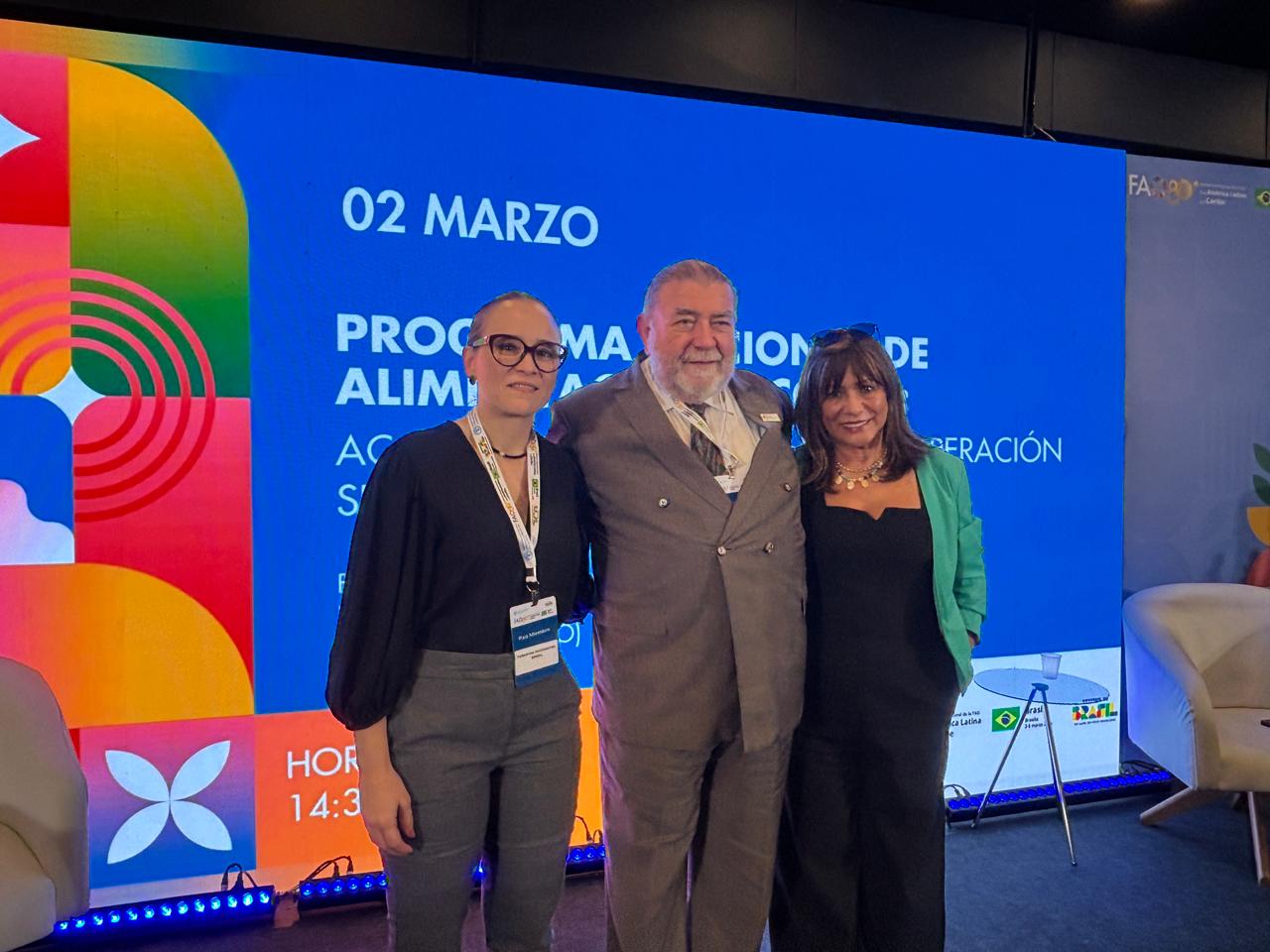
Brasília, Brazil, March 2, 2026 – The transformative potential of school feeding programmes was the focus of the thematic session National School Feeding Programme: Sustainable Actions in South-South Cooperation (Latin America and the Caribbean). The event was held as part of the 39th FAO Regional Conference, the main forum for discussing food security issues and setting regional priorities.
The opening was led by the President of the National Fund for Educational Development (FNDE), Fernanda Pacobahyba, who highlighted the importance of South-South cooperation to share solutions among countries, such as the advances of Brazil’s National School Feeding Programme (PNAE).
Among the innovations, she mentioned the increase in the percentage allocated to public procurement, which rose from 30 percent to 45 percent starting in 2026, as well as the progressive reduction of ultra-processed foods, limited to 10 percent this year. She emphasized that school feeding is a multifactorial policy.
Regarding international cooperation, she underscored the role of the Sustainable School Feeding Network (RAES), which brings together countries committed to advancing student coverage, food and nutrition education, public procurement from family farming, among other issues. “Through this Network, action plans, courses and training initiatives have been implemented to strengthen legislation, infrastructure and school feeding services,” she said.
“The focus has been on improving the quality and sustainability of programmes. We are fully aware that challenges of this magnitude can only be overcome through cooperation. We work on developing legal frameworks, producing evidence, strengthening institutions, training teams and improving programme infrastructure. South-South cooperation has played a strategic role by allowing solutions developed in our territories to be adopted and adapted by other countries.”
In turn, Ambassador Ruy Pereira, Director of the Brazilian Cooperation Agency (ABC) at the Ministry of Foreign Affairs, stated that linking family farming to school feeding programmes is a lever to advance social and economic development. He also highlighted the importance of RAES in Latin America and the Caribbean. “RAES brings together 18 countries. We are working to strengthen, expand, broaden coverage and consolidate school feeding,” he said.
The ambassador reiterated the importance of PNAE, given its commitment to promoting human dignity and ensuring universal coverage for all students enrolled in the public education system.
Finally, RAES Executive Secretary Najla Veloso presented concrete results of the international cooperation developed by the Brazil–FAO alliance in the region since 2009. According to her, the work has supported the generation of data and evidence to improve decision-making, infrastructure, and budget guarantees for universalizing programmes. Technical assistance actions have also been carried out to develop and update laws and public policies and to strengthen the institutional capacities of actors involved in school feeding.
Najla highlighted institutional progress in the region: there are currently eight specific school feeding laws, 30 programmes in operation, 11 inter-institutional committees, 13 regulatory frameworks ensuring social participation, and eight countries with menus designed by nutritionists. In ten countries, menus include fruits and vegetables, and another ten have regulatory frameworks focused on food safety.
“The RAES Network has driven the development of the regional school feeding agenda, which was collectively drafted and validated with the countries. Dialogue among countries, as well as shared experiences and innovations, have strengthened school feeding policy in the region.”
She added that school feeding programmes “promote the transformation of agrifood systems, generating impacts on education, health, nutrition, and rural and social development. They also guarantee the human right to adequate food for millions of students and contribute to achieving several SDG targets.”
Representing FAO, the Executive Secretary thanked the RAES managing institutions — ABC and FNDE — the member countries, all government focal points, and FAO country office teams for their dedication and support in implementing the Network.