FAO and the Government of Brazil are promoting this initiative within the framework of the Brazil-FAO South-South Cooperation Programme.
Paulo Beraldo and Palova Brito
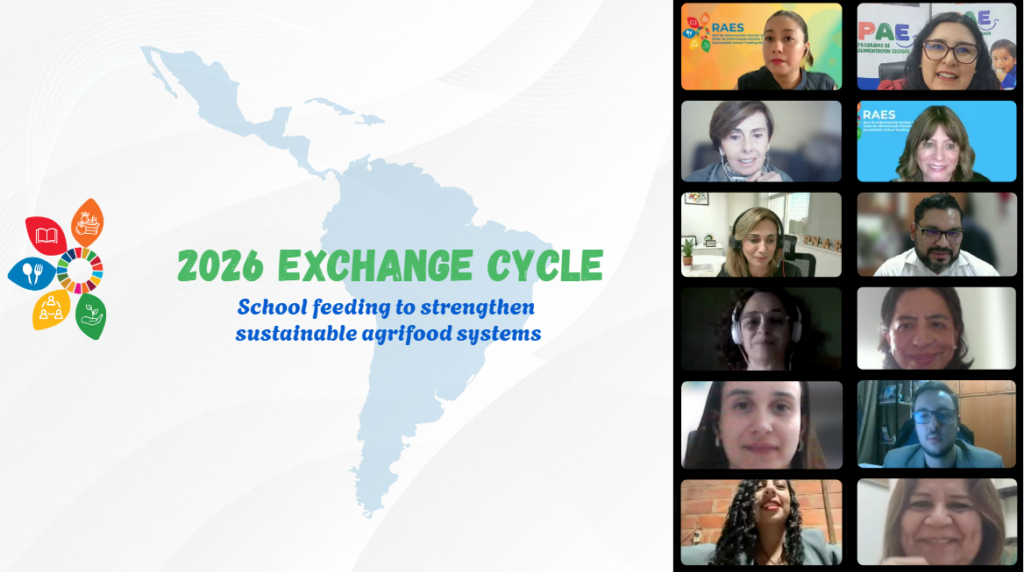
Brasilia, Brazil, 12 May 2026 – Around 380 professionals from 13 Latin American countries participated in the opening of the 2026 Exchange Cycle: School Feeding to Strengthen Sustainable Agrifood Systems, an initiative of the Sustainable School Feeding Network (RAES) aimed at strengthening the capacities of professionals linked to school feeding. The event was held virtually on 11 May.
The 2026 Exchange Cycle: School Feeding to Strengthen Sustainable Agrifood Systems brings together participants from Bolivia, Chile, Colombia, Costa Rica, Cuba, Ecuador, El Salvador, Guatemala, Honduras, Paraguay, Peru, the Dominican Republic and Uruguay. The cycle has 1,500 registered participants and will take place from 11 May to 19 June, with a 60-hour workload delivered virtually. In addition, weekly virtual meetings will be held to answer questions and further explore the topics addressed.
During the opening session, it was highlighted that the cycle aims to strengthen knowledge for the design, implementation and improvement of school feeding programmes (SFPs), promoting their articulation with local agrifood systems and family farming.
Likewise, the initiative seeks to contribute to the development of healthier, more resilient and culturally appropriate school environments. It is aimed at managers, technicians and professionals linked to national and local school feeding programmes, as well as representatives from ministries and related sectors, including Education, Agriculture, Health, Economy, Social Development and International Cooperation.
RAES is a trilateral South-South cooperation initiative on school feeding promoted by the Government of Brazil, through the Brazilian Cooperation Agency (ABC) and the National Fund for Educational Development (FNDE), together with member countries in the region, with the executive secretariat led by the Food and Agriculture Organization of the United Nations (FAO). The network currently comprises 18 countries.
Promoting practical solutions to address challenges
Cecilia Malaguti, responsible for trilateral south-south cooperation with international organizations at the Brazilian Cooperation Agency (ABC), highlighted that cooperation in school feeding also strengthens quality education, public health and local family farming. “This cycle is not limited to the exchange of knowledge, it will also promote practical solutions to local challenges.”
For Karine Santos, coordinator of the National School Feeding Programme, implemented by the FNDE, the initiative is an opportunity to strengthen capacities, exchange experiences and generate proposals aimed at consolidating more inclusive, resilient and sustainable programmes. “It will be possible to reflect, discuss and formulate improvement proposals that strengthen the shared commitment to transforming school feeding through concrete experiences capable of generating effective changes in the region.”
Najla Veloso, executive secretary of RAES and FAO senior school feeding specialist, highlighted the commitment of the Brazil-FAO South-South Cooperation Programme to capacity strengthening and regional exchange on school feeding. Since 2009, this Programme has already trained more than 41,000 professionals in Latin America and the Caribbean. “The exchanges are not only spaces for dialogue, but also opportunities to collectively address common challenges.”
FAO Nutrition Officer Israel Ríos underlined that school feeding plays a strategic role in the development of countries and emphasized that RAES contributes to the region through the construction of a Regional School Feeding Agenda, which promotes spaces for exchange, learning and innovative solutions. He stressed that school feeding is a key driver for transforming agrifood systems and guaranteeing the human right to food.
The participating countries were represented by the director of Peru’s school feeding programme, Scarlet Esmeralda Díaz Cáceres, who highlighted the importance of having training specifically designed for professionals in the sector. “The success of this cycle is reflected in the ability of each participant to strengthen knowledge, share experiences and generate proposals that positively impact the programmes of our countries,” she concluded, thanking the Brazil-FAO South-South Cooperation Programme for promoting spaces that consolidate school feeding in the region.