The Sustainable School Feeding Network (RAES) highlighted progress in promoting healthy diets and food, nutrition and environmental education across the region.
Paulo Beraldo and Palova Brito
Santiago, Chile, 29 October 2026 – The XXI Latin American Congress of Nutrition (SLAN 2026), held from 25 to 29 October in Santiago, Chile, brought together more than 1,000 health and nutrition professionals, including programme managers, representatives of academic institutions, international organizations and other stakeholders, to exchange scientific knowledge, share research findings and progress, and discuss food and nutrition challenges in Latin America and the Caribbean (LAC).
The congress was organized around seven thematic areas: 1) governance and public policies for healthy, sustainable and equitable food systems; 2) sustainable transitions in food production for the health, environment and economy of the future; 3) food environments and behaviour; 4) healthy and sustainable diets throughout the life course; 5) physical activity and its role in healthy and sustainable food systems; 6) commercial determinants and community action, integrating flavours and knowledge; and 7) innovation, science and technology for transformation. These thematic areas provided opportunities for the Food and Agriculture Organization of the United Nations (FAO) and governments to participate in various activities, including symposia, panels and side events.
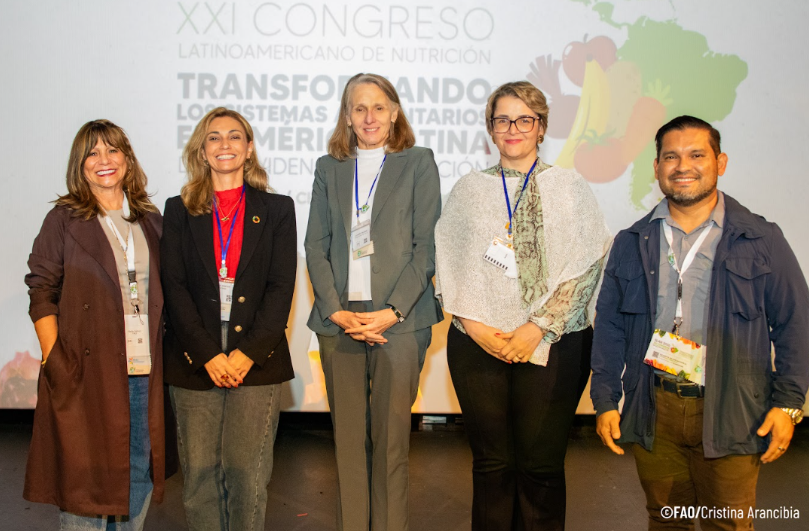
As part of the congress, the Sustainable School Feeding Network (RAES) held the symposium “RAES: An Overview of the Sustainable School Feeding Network, Its Results and Implications for Latin America and the Caribbean” on 28 October. The session connected with the congress’s thematic areas by addressing the contribution of school feeding to public policies, the promotion of healthy diets, the transformation of food environments and the strengthening of sustainable agrifood systems, based on scientific evidence and the exchange of experiences among countries.
RAES is an initiative promoted by the Brazilian Cooperation Agency (ABC) and the National Fund for Educational Development (FNDE), with the Food and Agriculture Organization of the United Nations (FAO) serving as its Executive Secretariat, within the framework of the Brazil-FAO South-South Cooperation Programme. This is the second time that the RAES Network has participated in SLAN. Its first participation took place in 2023, in the city of Cuenca, Ecuador.
Food and nutrition security, cooperation and public policies
During the symposium, moderated by Israel Ríos, FAO Nutrition Officer for Latin America and the Caribbean, participants discussed the links between food and nutrition security, international cooperation, public policies and the management of school feeding programmes. “SLAN is a key platform for scientific exchange and dialogue between academia and public policymakers. RAES’s participation strengthens the evidence base on school feeding and raises the visibility of its contribution to the transformation of agrifood systems,” said Israel Ríos.
Lynnette Neufeld, Director of FAO’s Food and Nutrition Division, presented an overview of food and nutrition security in the region in 2026 and the role of school feeding programmes in addressing malnutrition. She also highlighted the main challenge of ensuring healthy diets for all, linking this issue to the affordability of food.
Paola Barbieri, Project Analyst at ABC/MRE, addressed trilateral South-South Cooperation between Brazil and FAO as a strategy for promoting this dialogue at the regional level. She also highlighted progress in school feeding programmes across the region, emphasizing the work carried out by RAES.
RAES Executive Secretary Najla Veloso presented the Network’s trajectory, highlighting its main results and impacts. These include the development and validation of the Regional Agenda by member countries, which establishes seven priority areas for action: management and governance, healthy diets, food, nutrition and environmental education, public procurement from family farming, regulatory frameworks, financing, and monitoring and evaluation. These areas will guide the RAES Network’s upcoming activities through 2030.
The Executive Secretary emphasized the importance of the symposium as “an opportunity for dialogue between academia, research and public administration to generate scientific evidence and exchange knowledge on school feeding”.
Representing Brazil, Karine Santos, National Coordinator of the National School Feeding Programme (PNAE) at FNDE, presented the programme’s regulatory frameworks and recent progress, including measures to reduce the availability of ultra-processed foods in schools. Another key development was the increase to 45% in the share of resources allocated to purchasing food from family farmers for school feeding. This simultaneously strengthens the nutritional quality of meals and local economies.
The symposium concluded with reflections on the need to broaden the understanding of school feeding programmes beyond the provision of meals at school, adopting a holistic approach to these policies. It is important to recognize that these programmes are connected to broader agendas, including education, nutrition, health and agriculture. Participants also emphasized the urgent need to bring together institutions from different sectors of society to strengthen these programmes through data, evidence, conceptual contributions, technical assistance and support for expanding universal school feeding programmes, ensuring broad coverage and the nutritional quality required to meet students’ needs.