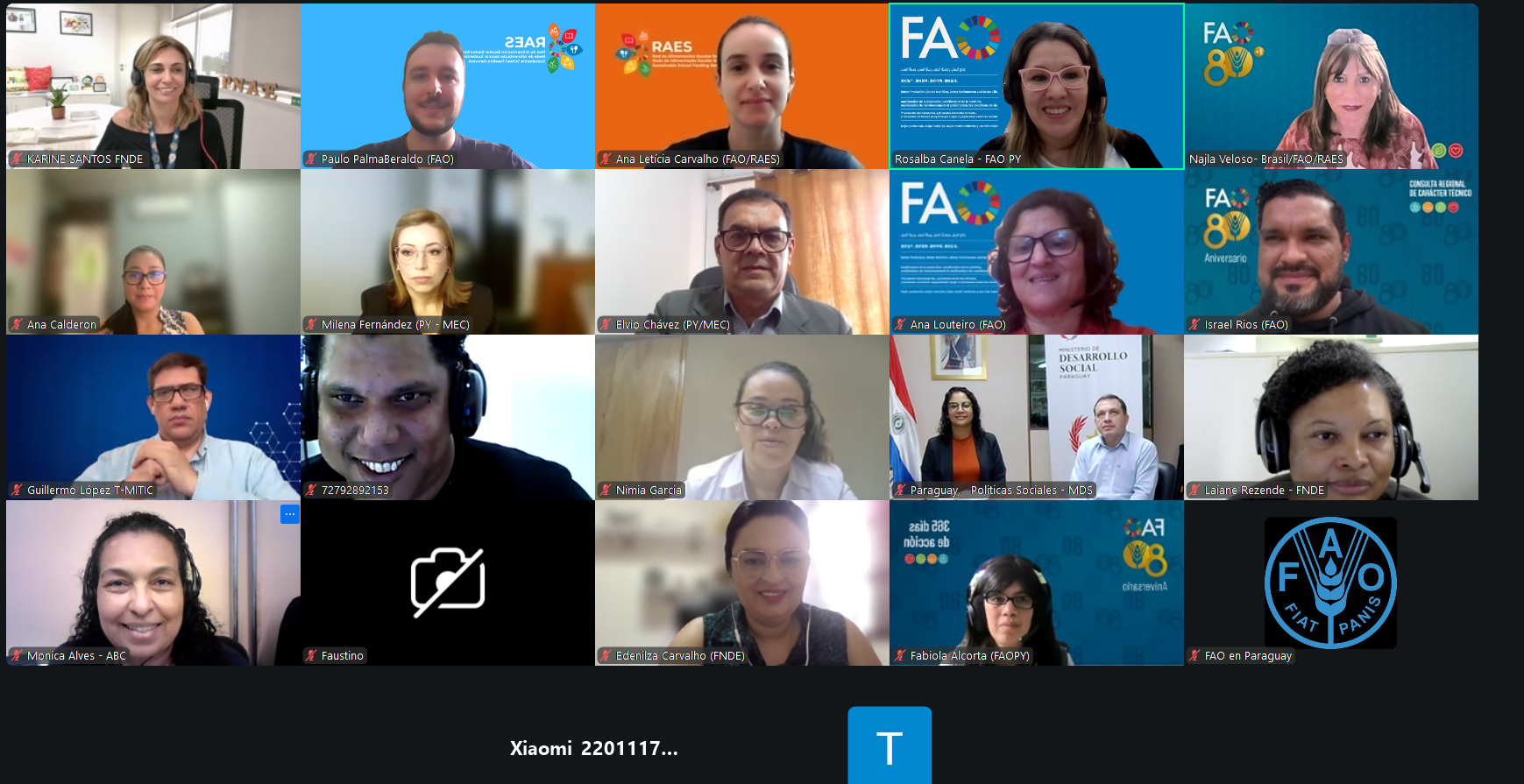
The meeting is part of an ongoing exchange cycle being carried out by the governments of Paraguay and Brazil, with the support of FAO Paraguay and RAES.
Paulo Beraldo
Brasília, Brazil, April 30, 2026 — The Government of Paraguay presented its experience in developing the Integrated School Feeding System (SIAE) to representatives of the Government of Brazil and the Sustainable School Feeding Network (RAES). The virtual meeting took place on April 30.
The meeting is part of an ongoing exchange cycle between the governments of Paraguay and Brazil, supported by FAO Paraguay and RAES.
The session focused on showcasing Paraguay’s progress. During the meeting, Paraguayan authorities explained that the SIAE system was built progressively, following the evolution of the school feeding programme itself. Paraguay’s Vice Minister of Social Development, Carlos París, noted that the tool was consolidated through practical implementation and benefited from lessons learned in cooperation spaces.
“It is a system that we developed over time, based on everything we learned through these exchanges,” he said. He highlighted that SIAE currently enables the integration of systems across different institutions, facilitating interoperability and real-time access to information, which strengthens decision-making and the monitoring of the school feeding programme.
Rebeca Chávez, Director of Planning for Development at Paraguay’s Ministry of Social Development (MDS), placed the initiative within the context of the Zero Hunger Programme and emphasized that the digitalization process aims to improve the efficiency of processes that were previously manual. According to her, SIAE has become “the backbone” of the programme’s implementation.
She also highlighted interinstitutional coordination through thematic working groups that help standardize procedures and streamline the flow of information. From FAO Paraguay, Programme Assistant Fabiola Alcorta described the school feeding programme as “emblematic” for the country and stressed the importance of exchange spaces. “Sharing experiences allows us to highlight good practices and learn from other contexts,” she said.
Karine Santos, General Coordinator of Brazil’s National School Feeding Programme (PNAE), congratulated Paraguay on the system’s comprehensive approach. She noted that the tool enables continuous monitoring, evaluation, and adjustment of public policy. “It is a robust system, integrating multiple data sources, which is essential for review and feedback processes. This work can serve as a reference for other countries,” she stated.
Representing the RAES Executive Secretariat, Najla Veloso emphasized that such initiatives reflect the network’s purpose. “This is why we exist: to support countries’ progress and promote the exchange of experiences so that we can move forward together,” she said.
Finally, FAO Nutrition Officer Israel Ríos also praised the development of Paraguay’s system and stressed that the experience should be shared regionally. “We should not miss the opportunity to showcase this progress,” he concluded.
The meeting brought together representatives and professionals from Paraguay’s Ministries of Education (MEC), Social Development (MDS), and Information and Communication Technologies (MITIC), as well as FAO Paraguay, FAO-SLM, Brazil’s National Fund for Educational Development (FNDE), the Brazilian Cooperation Agency (ABC), and the Secretariat of the Sustainable School Feeding Network (RAES).