The RAES Network presented its experience in sustainable school feeding during the session “Agroecological School Feeding and Urban-Rural Linkages” on November 19.
Brasilia, Brazil, November 24, 2026 – The Sustainable School Feeding Network (RAES) participated in the 3rd Regional Forum of the Milan Pact on Urban Food Policy for South America, held from November 17 to 19 in Curitiba, Paraná, Brazil. At the same venue, the 1st International Seminar on Urban and Peri-Urban Agriculture took place from November 16 to 18. Both events brought together governments, universities, civil society organizations and international organizations from Brazil, Argentina, Chile, Colombia, Ecuador, Mexico, Peru and Uruguay.
RAES took part in the session “Agroecological School Feeding and Urban-Rural Linkages” on November 19, which addressed the strategic role of school feeding in promoting food and nutrition security (FNS) governance and implementing sustainable food systems. The session also featured experiences from the Municipality of Porto Alegre’s network-based governance initiative, which discussed the challenges and multiple benefits of public food procurement for school feeding, farmers, local production and the city.
The Instituto Comida do Amanhã presented the Agroecological PNAE project, which is being implemented in four Brazilian municipalities. The municipality of São José dos Pinhais, Paraná, shared its experience as a participant in this project, which seeks to promote the agroecological transition of rural properties through public procurement for school feeding. Presented as a reference for urban-rural linkages in the Curitiba Metropolitan Region, the initiative supplies meals daily to more than 29,000 students in the municipal education system.
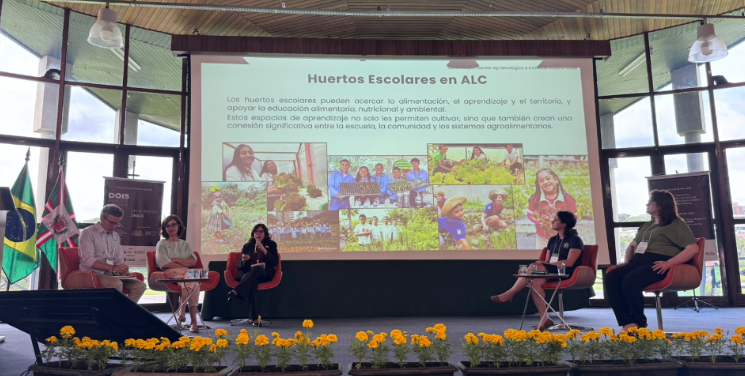
RAES’s presentation covered its work under the Brazil-FAO South-South and Triangular Cooperation Programme, the Sustainable Schools Methodology and its contributions to integrating school feeding, food and nutrition education, school gardens and family farming. The RAES Regional Agenda was also presented, highlighting priorities and opportunities for strengthening school feeding programmes in Latin America and the Caribbean, as well as the potential for exchanging experiences, fostering learning among countries and adapting good practices to different territorial and institutional contexts.
At the meeting, the Network was represented by Miriam de Oliveira, who highlighted that exchanges not only connect people, teams and governments, but also promote successful experiences that can be adapted to different contexts, accelerating learning processes, expanding opportunities and addressing problems collectively. According to her, successful experiences, adapted to each context, accelerate learning processes and help solve problems collectively.
RAES is an initiative promoted by the Brazilian Cooperation Agency (ABC) and the National Fund for Educational Development (FNDE), with the Food and Agriculture Organization of the United Nations (FAO) responsible for its Executive Secretariat, under the Brazil-FAO South-South Cooperation Programme.
About the event
The Municipality of Curitiba organized the Forum and the Seminar in partnership with the Milan Pact, the Ministry of Development and Social Assistance, Family and the Fight against Hunger, the Instituto Comida do Amanhã and the Italian Agency for Development Cooperation, as well as the municipalities of Milan and Esteban Echeverría. The events also brought together municipal bodies and national and international partners, with the involvement of the International Relations Advisory Office (Arin) and the Municipal Secretariat for Food and Nutrition Security (SMSAN). FAO, Embrapa, Sesc, PUCPR and the Mercociudades network were among the supporting organizations.
The Forum’s programme, held from November 17 to 19, addressed other topics, such as governance and food loss and waste. On the final day, the Curitiba Charter was presented. The document reinforces the role of cities and metropolitan regions in developing policies for agrifood systems and proposes maintaining coordination among participants through the exchange of practices and the monitoring of progress.