The initiative aims to strengthen legislative and public policy capacities to promote healthy and sustainable school food environments in Colombia, grounded in evidence and the human right to food.
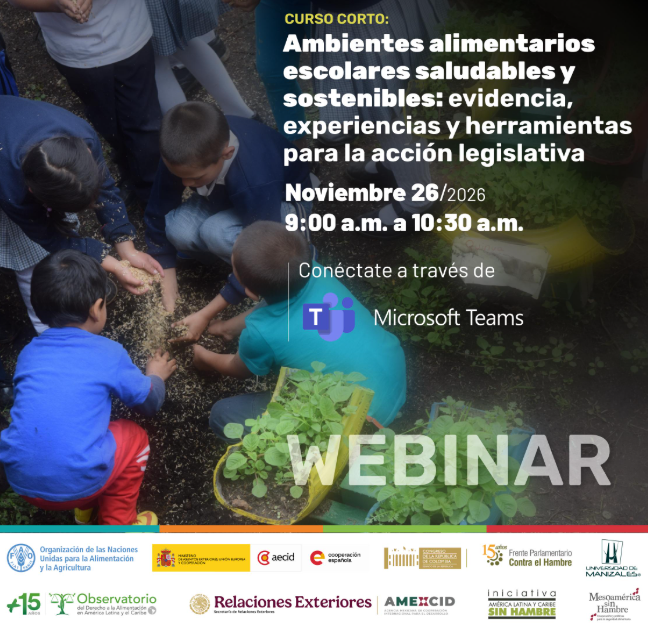
Brasilia, Brazil, November 26, 2026 – The Food and Agriculture Organization of the United Nations (FAO), in partnership with the University of Manizales, the Observatory of the Right to Food in Latin America and the Caribbean, AECID and AMEXCID, launched, on November 26, 2026, a training initiative aimed at strengthening the technical capacities of members of Congress, members of Legislative Technical Units (UTL), council members, deputies and their support teams in Colombia.
Representing FAO in Colombia, Diego Mora, Programme Officer, highlighted that there are several challenges related to food that go beyond hunger and include malnutrition in all its forms and the rise of obesity, including among students. He emphasized the relevance of training initiatives such as this one and thanked the Sustainable School Feeding Network (RAES) for its “permanent commitment to strengthening school feeding in the region”. He described it as “a tremendous ally that helps provide a broader perspective and think about solutions to national problems, since there are many experiences in Latin America and the Caribbean that can contribute”.
In turn, Senator Ana Paola García, coordinator of the Parliamentary Front against Hunger, highlighted the importance of promoting spaces for reflection and dialogue that contribute to the development of regulatory frameworks capable of improving the lives of communities. She emphasized the relevance of having evidence, data and technical knowledge to inform public decision-making and the development of policies that effectively respond to the needs of the population.
RAES was represented by its Executive Secretary, Najla Veloso, who congratulated everyone on the initiative to carry out this “important capacity development strategy”, reaffirming the relevance of school feeding programmes, regional cooperation and the exchange of knowledge and experiences among countries to advance the construction of healthier, more sustainable and inclusive school feeding systems.
Veloso added that the region has approximately 170 million students, while 80 million have access to school feeding. “We face the major challenge of making school feeding universally available — with high nutritional quality and on every school day — to students in the region, in order to ensure that they enjoy the standard of living established in the International Covenant on Economic, Social and Cultural Rights, with the human right to adequate and healthy food at school guaranteed to everyone”.
She also highlighted the impacts of providing healthy food on students’ health, education and the promotion of a country’s social, economic and environmental development and transformation. To conclude, she commented that regulatory frameworks are very important for institutionalizing and increasingly strengthening programmes at the national level, and that the role of parliaments at the national and regional levels is “fundamental to ensuring the successful implementation of programmes, overseeing their implementation, as well as consolidating financial sustainability to ensure their continuity in scenarios of changes in administration, crises and economic fluctuations”.
The training
Lasting three months, from November 2026 to February 2027, the training seeks to support the formulation, analysis, discussion, implementation and monitoring of legislative initiatives and public policies related to the promotion of healthy and sustainable school food environments in the country.
The programme includes five thematic modules that will address the protection of human rights through school food environments; the importance of this topic for the legislative agenda; the components of healthy and sustainable school food environments; international experiences in using legislation to transform these environments; and the development of a legislative agenda for Colombia.
The initiative seeks to contribute to improving decision-making processes, based on evidence and from the perspective of the human right to food.
Participants
The target audience includes members of Congress and legislative teams interested in the areas of health, education, childhood, agriculture and social development, as well as representatives of councils and territorial assemblies from Bogotá, Medellín and Antioquia.
The programme will be delivered in person, in Bogotá, and virtually, with a certificate of participation from the University of Manizales. At the end of the training process, the closing forum “School food environments: opportunities for a legislative agenda in Colombia” will be held, organized by FAO and the partners.