The meeting aimed to learn about the experience of creating and consolidating RAES and to discuss how this experience could contribute to the creation and institutionalization of a potential future CPLP Network.
Brasilia, Brazil, July 22, 2026 – The Sustainable School Feeding Network (RAES) was invited to participate in a meeting with representatives from countries of the Community of Portuguese-Speaking Countries (CPLP), held on July 22, to present its trajectory, governance model, and results achieved in promoting school feeding in Latin America and the Caribbean. The meeting was organized by the Brazilian Cooperation Agency (ABC) and the National Fund for Education Development (FNDE).
The meeting aimed to learn about the experience of creating and consolidating RAES and to discuss how this experience could contribute to the creation and institutionalization of a potential future CPLP Network on School Feeding, Nutrition, and Health.
RAES is jointly implemented by the National Fund for Education Development (FNDE) and the Brazilian Cooperation Agency (ABC), with the executive secretariat led by the Food and Agriculture Organization of the United Nations (FAO). The Network is composed of 18 member countries.
The CPLP initiative to create a similar network was agreed upon during the 14th Meeting of CPLP Ministers of Education, held in May 2026 in Dili, Timor-Leste, and is also the result of a recommendation from the 4th International Seminar on Good Practices in School Feeding in the CPLP.
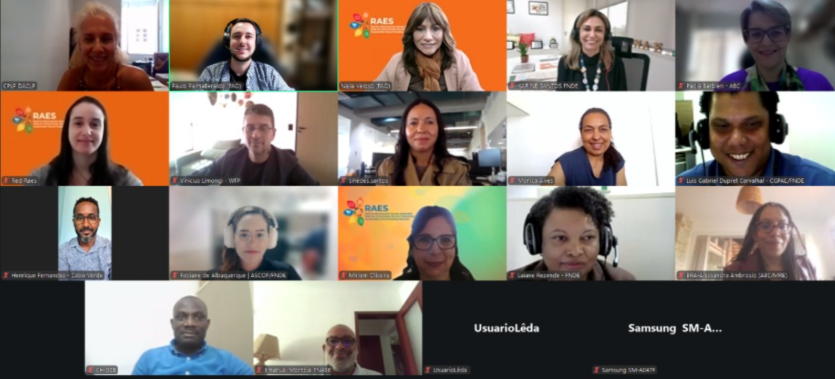
In addition to the RAES team, representatives from the National Fund for Education Development (FNDE), the Brazilian Cooperation Agency (ABC), Cabo Verde, Mozambique, São Tomé and Príncipe, and the Executive Secretariat of the CPLP participated in the meeting.
During the meeting, Paola Barbieri, Project Analyst at the Brazilian Cooperation Agency (ABC), highlighted that Brazilian international cooperation in school feeding is part of a commitment built over decades. She emphasized that, since 2008, Brazil has intensified its work in partnership with international organizations in different areas, including school feeding, generating interest among several countries in learning from the Brazilian experience.
Presenting RAES’ trajectory, Najla Veloso, Executive Secretary of RAES and FAO school feeding specialist, highlighted that the history of the Network does not begin with its formal creation in 2018, but rather with the technical cooperation developed by the Government of Brazil and FAO with countries in Latin America and the Caribbean since 2009. “This process made it possible to build relationships of trust, strengthen capacities, and consolidate a permanent agenda of exchange among countries.”
It was also highlighted that the formalization of countries’ adhesion to RAES in 2024 was the result of a process of institutional maturation, driven by lessons learned during the COVID-19 pandemic, “when the importance of permanent mechanisms for cooperation and networking became even more evident.”
Another point emphasized was that RAES’ work is based, among other principles, on promoting school feeding as a public policy aimed at guaranteeing the human right to adequate food for all students enrolled in public education systems.
Najla Veloso reinforced that the success of the Network is directly linked to the ongoing commitment of its members. According to her, “a network only produces results when there is daily work, constant coordination, and collective engagement to keep cooperation among countries alive.”
During the meeting, the development of the RAES Regional Agenda was also presented. This instrument guides the Network’s strategic priorities for the coming years and strengthens cooperation among countries on issues such as governance, healthy eating, food and nutrition education, and public procurement from family farming.
Karine Santos, coordinator of Brazil’s National School Feeding Programme, implemented by FNDE, highlighted that maintaining a regional network requires continuous investment, a dedicated team, and resources to enable missions, exchanges, and technical cooperation activities. Karine also emphasized the importance of the RAES Secretariat, which is responsible for promoting, coordinating, and supporting the joint planning of activities, and noted that the results achieved by RAES demonstrate the progress made through cooperation between the Government of Brazil, FAO, and participating countries.
During the meeting, the Centre of Excellence Against Hunger in Brazil also presented its experience working with school feeding policies, particularly the role of the Global School Meals Coalition.
By sharing its experience with the CPLP, RAES reaffirmed its commitment to South-South Cooperation and to strengthening public policies on school feeding, making available the lessons learned throughout nearly two decades of regional work to support the creation of the future network of Portuguese-speaking countries.