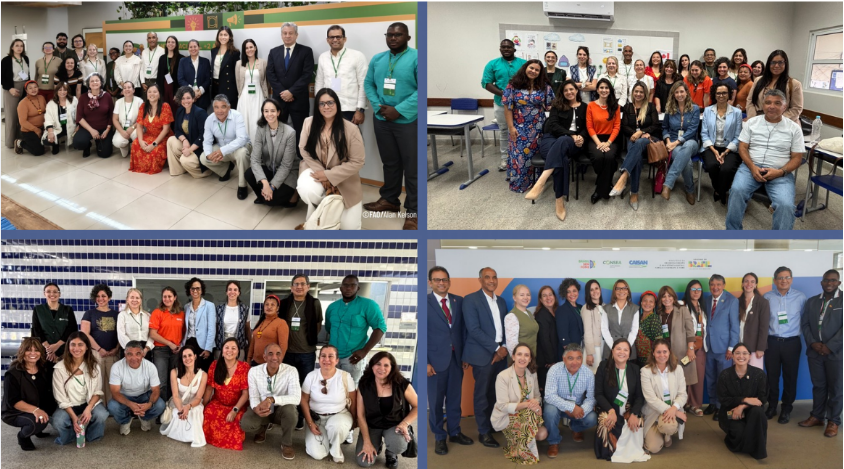
The activity consisted of a visit to learn about the implementation of the Federal District’s school feeding programme at the Plan Piloto Public Full-Time Bilingual School for Brazilian Sign Language (Libras) and Written Portuguese, an educational institution specialized in serving deaf students.
Paulo Beraldo
Brasília, Brazil, June 11, 2026 – The Sustainable School Feeding Network (RAES) supported one of the activities of the technical meeting “Governance for Food Security and Nutrition (FSN): Institutional Frameworks, Progress and Challenges in Latin America and the Caribbean,” which brought together representatives from 14 countries across the region in Brasília, Brazil, from June 8 to 10. The activity supported by RAES consisted of a field visit to observe the implementation of the Federal District’s school feeding programme at the Bilingual Full-Time Public School for Brazilian Sign Language (Libras) and Written Portuguese, an educational institution specialized in serving deaf students.
During the technical meeting, experts, practitioners and policymakers exchanged experiences on how to strengthen food security and nutrition governance in their countries and advance towards concrete results. Discussions focused on institutional, regulatory and coordination mechanisms that enable the design and implementation of more effective and inclusive policies to ensure the human right to adequate food.
The mission was organized by the Food and Agriculture Organization of the United Nations (FAO), under the Better Nutrition area, with technical support from the Inter-American Development Bank (IDB). As part of the programme, RAES supported the technical visit to the public school, where participants learned about experiences related to school feeding and the intersectoral coordination of food security policies.
RAES is a trilateral South-South cooperation initiative on school feeding promoted by the Government of Brazil through the Brazilian Cooperation Agency of the Ministry of Foreign Affairs (ABC/MRE) and the National Fund for Educational Development of the Ministry of Education (FNDE/MEC), together with member countries across the region, with the Food and Agriculture Organization of the United Nations (FAO) serving as its Executive Secretariat.
“Although national contexts differ, countries in Latin America and the Caribbean face common challenges in strengthening FSN governance: consolidating intersectoral coordination mechanisms, ensuring the effective participation of multiple stakeholders, strengthening institutions, and advancing towards more effective and inclusive public policies,” explained Daniela Godoy, Senior Food Security and Nutrition Policy Officer at FAO’s Regional Office for LAC.
The technical meeting took place within the framework of Brazil’s National Meeting of the 6th National Conference on Food Security and Nutrition +2, organized by the National Council for Food Security and Nutrition (CONSEA). The conference brought together around 350 representatives from civil society and government, including members of the National CONSEA, the Interministerial Chamber for Food Security and Nutrition (CAISAN), state councils and other stakeholders involved in the country’s food security and nutrition agenda.
School visit
To observe how food security and nutrition governance is translated into practice at the local level, RAES organized a technical visit to the Full-Time Bilingual Libras and Written Portuguese Public School of Plano Piloto, an educational institution specialized in serving deaf students, students with hearing impairments, and hearing children of deaf parents. The school uses Libras (Brazilian Sign Language) as its first language and written Portuguese as its second language.
The activity enabled participants to gain first-hand insight into how different institutions and professionals coordinate efforts to ensure the operation of Brazil’s National School Feeding Programme (PNAE), which reaches 40 million students on every school day. During the visit, country representatives exchanged experiences with stakeholders involved in programme implementation, including education authorities, school managers, nutritionists and representatives of family farming organizations.
According to Najla Veloso, Senior School Feeding Specialist at FAO for Latin America and the Caribbean and Executive Secretary of RAES, school feeding programmes provide a concrete example of intersectoral governance. “School feeding programmes demonstrate how different sectors must work in a coordinated manner to achieve a common goal. Education, health, nutrition, agriculture, technical assistance, rural extension and social development are some of the areas involved in this process,” she said.
Veloso highlighted that the visit aimed to showcase the coordination among the institutions that contribute to the programme in Brasília, including the National Fund for Educational Development (FNDE), the Federal District State Department of Education (SEEDF), the Technical Assistance and Rural Extension Company of the Federal District (EMATER-DF), and school staff. “We sought to demonstrate how this joint effort ensures that school meals reach all students in public schools and respond to their specific needs,” Najla concluded.
SEEDF professionals explained how the programme operates in Brasília, where it serves 400,000 students daily across 692 educational institutions. They also reported that school meals include 83 different food products, among them 46 varieties of fruits and vegetables and 37 items sourced from family farming. In addition, they noted that approximately 1,000 local farmers benefit from public procurement for the school feeding programme. Besides that, EMATER explained that technical assistance is fundamental to strengthen family farming.