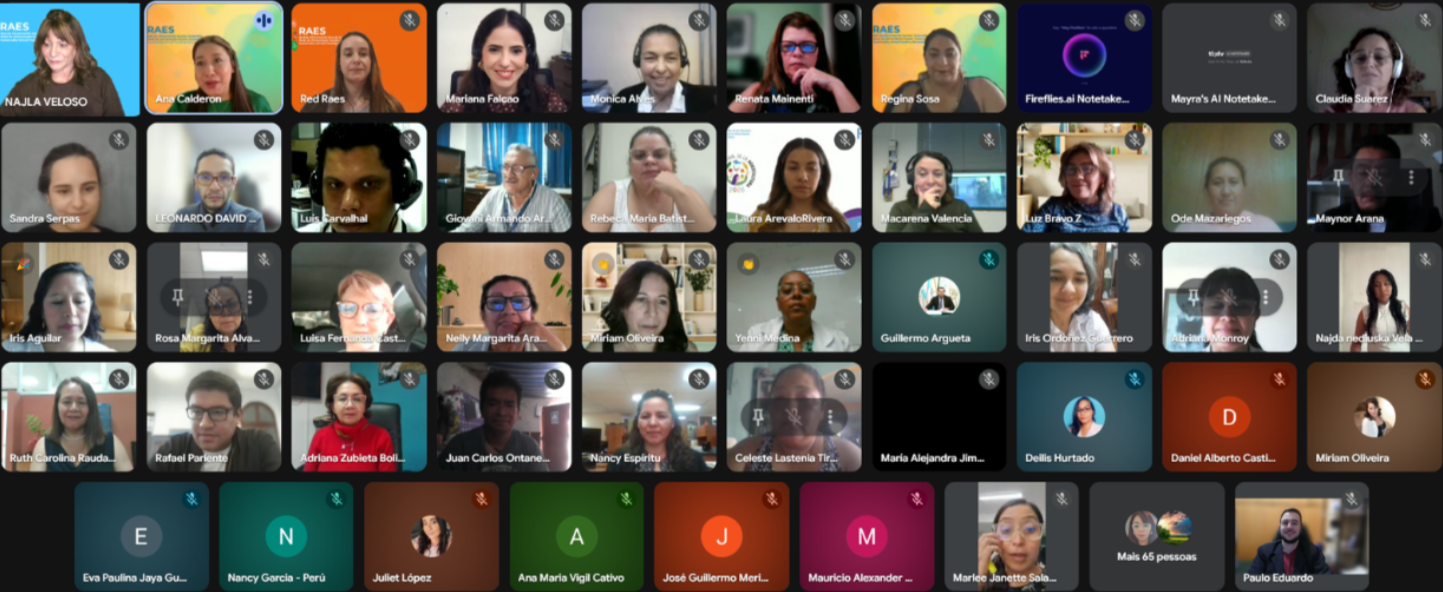
The initiative to exchange experiences among managers and experts was promoted by Brazil–FAO Cooperation together with member countries of the RAES.
Paulo Beraldo
Brasília, Brazil, June 25, 2026 – A total of 1,566 professionals from Latin America strengthened their capacities in school feeding programmes after completing the “2026 Exchange Cycle: School feeding for strengthening sustainable agrifood systems,” an initiative led by the Sustainable School Feeding Network (RAES). Participants highlighted that school feeding is a strategic public policy with impacts on health, nutrition, and rural development, and emphasized the value of regional exchange to strengthen its implementation.
The cycle brought together participants from 13 countries: Bolivia, Chile, Colombia, Costa Rica, Cuba, Ecuador, El Salvador, Guatemala, Honduras, Paraguay, Peru, the Dominican Republic, and Uruguay. The activity took place from May 11 to June 25, with a total duration of 60 hours in virtual format, complemented by weekly exchange sessions to answer questions, discuss content, and carry out collaborative learning activities. It also featured a platform developed by RAES, with educational materials available to students, as well as support from a tutor.
Throughout the cycle, more than 12 regional and national experiences aimed at strengthening school feeding programmes were presented, allowing participants to share progress, lessons learned, and practical solutions implemented in different contexts across Latin America. Key topics included school feeding as an integrated public policy, intersectoral governance, food and nutrition education, the promotion of healthy and sustainable diets, public procurement from family farming, articulation with local agrifood systems, and the use of communication as a tool to foster better eating habits.
The training was designed to strengthen knowledge for the design, implementation, and improvement of school feeding programmes, emphasizing their articulation with agrifood systems. Participants included public policy managers, nutritionists, and technical staff from different sectors linked to school feeding, including education, agriculture, health, nutrition, economy, social development, and cooperation, among others. It also included professionals interested in the topic in these countries and engaged in national or local programmes. Participants are involved in areas such as public procurement, food and nutrition education, environmental sustainability, gender, and youth.
RAES is a trilateral South-South cooperation initiative on school feeding promoted by the Government of Brazil, through the Brazilian Cooperation Agency (ABC) and the National Fund for the Development of Education (FNDE), together with member countries of the region, with the Executive Secretariat led by the Food and Agriculture Organization of the United Nations (FAO). The network currently comprises 18 countries.
During the cycle, participants discussed the strategic role of school feeding within agrifood systems and food and nutrition security policies. In Latin America and the Caribbean, around 80 million students are covered by school feeding programmes. Discussions also addressed intersectoral governance, regulatory frameworks, public procurement mechanisms that facilitate the participation of family farming, and proposals were developed to improve SFPs adapted to each country’s context.
At the closing session of the cycle, Renata Mainenti, Deputy Coordinator of Brazil’s National School Feeding Programme, implemented by FNDE, stated that the cycle was an opportunity to strengthen capacities and generate proposals aimed at improving school feeding in each participating country. “We know there is no perfect or definitive programme. School feeding is a public policy in constant evolution to respond to new social, economic, environmental, and technological dynamics.”
Similarly, ABC/MRE, through the Deputy Coordinator of Brazil–FAO Trilateral South-South Cooperation, Mariana Falcão, noted that these activities consolidate international technical cooperation by reflecting its principles and guidelines, as they strengthen participation and horizontality in actions, while ensuring countries’ sovereignty in promoting their own progress. “This cycle brought together 1,566 professionals from 13 countries, reflecting the region’s growing interest in strengthening school feeding programmes”.
Najla Veloso, Senior School Feeding Specialist at FAO and Executive Secretary of RAES, stated that one of the most important tasks of this cooperation to strengthen school feeding in countries is to provide professionals with opportunities to learn about advances made in the region in a simple, practical, and concrete way. “It is also important to understand the perspectives and advocacy positions of experts on each topic discussed. These exchanges bring theory and practice into the same dialogue, generating knowledge capable of changing realities, improving the different components of school feeding, and positively impacting local agrifood systems.”
Since the beginning of Brazil–FAO South-South Trilateral Cooperation work on school feeding in 2009, more than 42,000 professionals in the region have been trained.
Testimonials
Among several testimonials, Claudia Suárez, lecturer at the School of Nutrition of the University of the Republic (Uruguay), said the experience reaffirmed that school feeding must be understood as a strategic public policy that goes beyond food provision. “The knowledge acquired provides me with stronger technical foundations to better support the implementation of the Sustainable Schools methodology in Uruguay,” she added.
Gabriela Costa, nutritionist at the National Institute of Food and Nutrition (Paraguay), said she was able to learn and share challenges with professionals from different countries, enriching her perspective on the local programme. Laura Mena, head of the Food and Nutrition Department responsible for implementing the school feeding programme at the Ministry of Education of Costa Rica, stated that what most stood out was the importance of linking local family farming to school feeding, improving food quality and promoting territorial development.
Adriana Zubieta, Head of the Food and Nutrition Unit at the Ministry of Health and Sports of Bolivia, said that school feeding is the policy “with the greatest capacity to generate simultaneous impacts on health, nutrition, and rural development,” and that schools are the best place to build habits that can transform the lives of students, families, and communities.
Video: RAES Regional Agenda for Sustainable School Feeding in Latin America and the Caribbean