Latin America and the Caribbean (LAC) continues to face significant challenges in ensuring that all people have access to adequate food. By 2024, the region managed to reduce hunger, declining from a peak of 6.1% (39.8 million people) in 2020 to 5.1% in 2024, equivalent to approximately 34 million people. However, marked differences persist among subregions. While South America has driven regional progress, recording a prevalence of 3.8%, the Caribbean continues to experience persistently high levels, close to 17.5%.
Regarding moderate and severe food insecurity, it has steadily declined for the fourth consecutive year since its peak in 2020 (33.7%), reaching an estimated 25.2% in 2024 (FAO et al., 2025), making LAC the only region in the world to show sustained improvements in recent years.
However, the region has the highest cost of a healthy diet in the world, averaging 5.16 PPP dollars per person per day, resulting in more than 181 million people still unable to afford a healthy diet. This highlights deep inequalities in access to nutritious and affordable food.
At the same time, significant nutritional challenges remain. Childhood overweight remains at 5.5%, while adult obesity increased from 12.1% in 2012 to 15.8% in 2022 (FAO et al., 2025), highlighting the persistence of the double burden of malnutrition in the region.
In recent years, several LAC countries have steadily advanced in adopting the Food System-Based Dietary Guidelines (FBSF) approach. This approach has become a key tool for improving food systems governance, strengthening intersectoral coordination, and providing greater coherence to policies aimed at promoting access to healthy diets and their linkage with agrifood systems.
The FBSF approach represents a significant shift from traditional dietary guidelines by offering a more comprehensive perspective based on scientific evidence and the analysis of the food system as a whole (Bengoa, 2022). It also incorporates the participation of multiple sectors: health, agriculture, environment, economy, and culture. Through this perspective, recommendations become more relevant to each country, promoting healthy and sustainable diets that consider not only nutrition, but also the social, economic, and environmental impacts of food systems (FAO, 2024).
Recent studies show that countries need more structured guidance to integrate sustainability into their dietary guidelines (Sifontes, 2024). In response, FAO has developed a food systems-based methodology that includes concrete steps for incorporating environmental, economic, and social criteria throughout the formulation process. Several countries have already begun applying this methodology and are generating valuable lessons learned (Islas-Ramos et al., 2024).
In this context, it is essential to have spaces that facilitate technical exchange and collective learning among countries, such as the Community of Practice on Food System-Based Dietary Guidelines in Latin America and the Caribbean. This is a space where countries can share their progress, challenges faced, lessons learned, and practices that have proven effective in implementing the FBSF approach. This type of collaboration not only strengthens national processes, but also promotes subregional synergies and contributes to accelerating the transformation toward healthier and more sustainable food systems.
General objective:
To facilitate a space for the exchange of experiences and lessons learned among Guatemala, El Salvador, Panama, and Paraguay regarding the development and implementation of the FBSF approach, with the aim of strengthening national processes and promoting subregional cooperation.
Specific objectives:
- Present the experience of the four countries, emphasizing their progress, application of the FAO methodology, challenges, adopted solutions, and achieved results.
- Generate a space for technical dialogue among key stakeholders involved in the FBSF process.
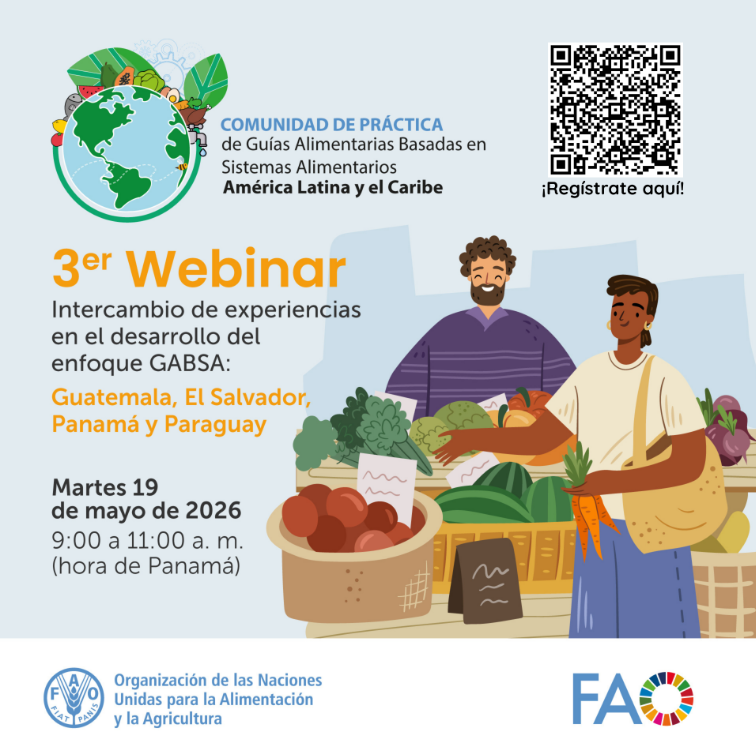
Webinar: Exchange of experiences in the development of the FBSF approach: Guatemala, El Salvador, Panama and Paraguay
Date: Tuesday, May 19, 2026
Time: 09:00 – 11:00 Panama time
Registration and access link for the webinar:
Microsoft Teams Webinar Registration