The country has launched the implementation of a pilot project of the Sustainable Schools methodology, created through the Brazil-FAO Trilateral South-South Cooperation programme, which promotes healthier, more sustainable educational environments connected to local development.
Paulo Beraldo and Hernan Criado
Montevideo, Uruguay, June 23, 2026 – On June 16, Uruguay launched the implementation of a pilot project of the Sustainable Schools methodology through an awareness-raising session aimed at professionals involved in school feeding from different educational institutions across the country. The virtual activity brought together experts and professionals responsible for school feeding, technical teams, and representatives from various Uruguayan departments participating in the implementation of the initiative.
The process is being led by the School of Nutrition of the University of the Republic (EN-Udelar), in coordination with the School Feeding Programme (PAE), the Ministry of Public Health (MSP), the Sustainable School Feeding Network (RAES), the Brazil-FAO Trilateral South-South Cooperation Programme, and the FAO Representation in Uruguay.
Since 2012, the Sustainable Schools methodology has been implemented across Latin America and the Caribbean through the Brazil-FAO Trilateral South-South Cooperation Programme on school feeding. The initiative is carried out by the Brazilian Cooperation Agency (ABC), the National Fund for Educational Development (FNDE), and the Food and Agriculture Organization of the United Nations (FAO), with the objective of sharing lessons learned and overcoming national and local challenges in order to scale up implementation within public education systems across participating countries.
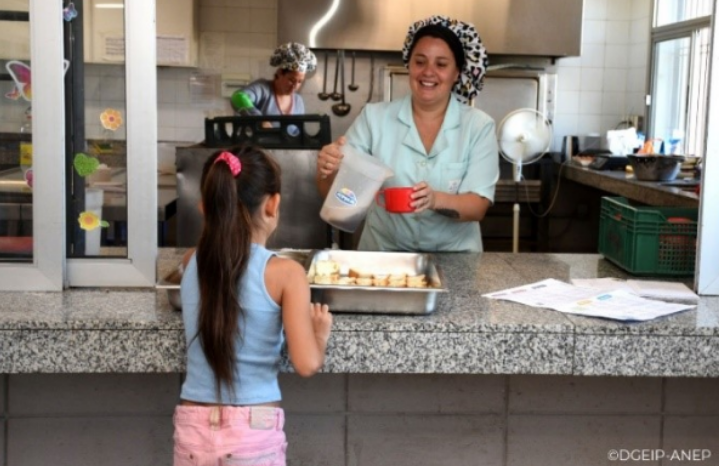
The methodology is based on six components: i) inter-institutional and intersectoral coordination; ii) social and citizen participation; iii) food and nutrition education; iv) improvement of school feeding infrastructure; v) adoption of adequate, healthy menus aligned with local culture; and vi) establishment of direct procurement from local family farmers for school feeding.
The Sustainable Schools pilot project seeks to strengthen the School Feeding Programme (SFP) of the General Directorate of Initial and Primary Education of the National Public Education Administration (DGEIP-ANEP) through a methodology that promotes school feeding as a tool for sustainable development and the realization of the right to adequate food.
RAES is a trilateral South-South cooperation initiative on school feeding promoted by the Government of Brazil, through ABC and FNDE, together with member countries in the region, with FAO serving as the Executive Secretariat.
Uruguay and the Sustainable Schools Methodology
Since 2023, Uruguay has participated in RAES through the SFP, contributing to the Network’s work and developing different experiences related to the implementation of the methodology in the country. Building on these efforts, in 2026 a cooperation agreement between the SFP and FAO in Uruguay is being implemented to develop the pilot project in six educational institutions located in the departments of Canelones, San José, and Maldonado. This experience will make it possible to validate a management and technical support model that can be replicated nationwide, contributing to improving the quality and sustainability of the Programme.
In addition to the methodology, the pilot project also incorporates the “7 Practices in Educational Centres to Protect Children and Adolescents from Overweight and Obesity,” an initiative promoted by ANEP, the MSP, the National Food Institute of the Ministry of Social Development (INDA-MIDES), and the United Nations Children’s Fund (UNICEF) to encourage healthy eating habits in educational institutions.
Virtual Training Session
Representing the School of Nutrition at Udelar, Elena Ongay presented the work the institution will undertake to provide technical support throughout the adaptation and implementation process of the pilot project in the selected educational institutions. Elisa Bandeira, FAO Liaison Specialist for Food Security and Nutrition Processes in Uruguay, highlighted the value of this experience in deepening technical cooperation aimed at strengthening the SFP through regional exchange promoted by RAES and the adaptation of methodological tools to the national context.
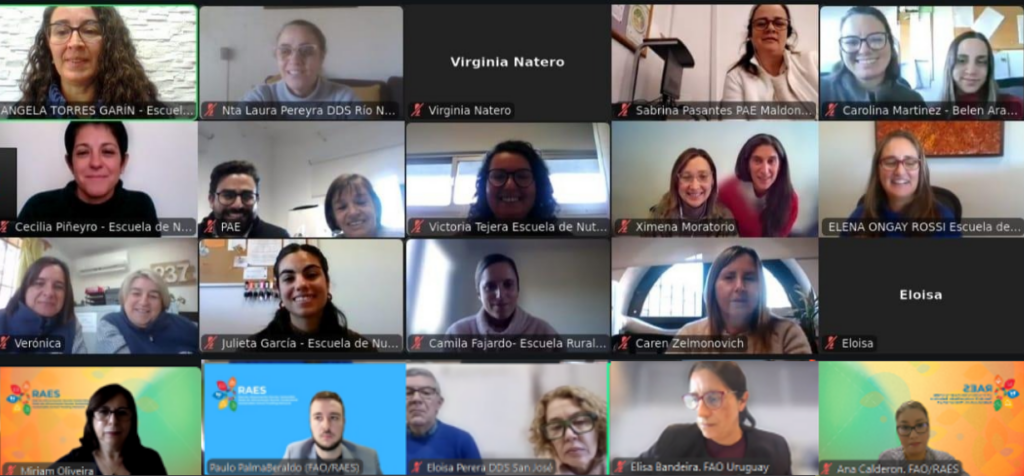
Yanira Calderón, RAES Capacity Development Consultant, presented the methodology’s main concepts, stages, and tools, highlighting its contributions and key elements. She noted that the implementation of the methodology seeks to strengthen coordination among education, health, school feeding, and local development sectors, promoting environments that contribute to students’ well-being, learning, and the development of healthy habits.
Miriam Oliveira, Assistant to the RAES Executive Secretariat, addressed the important role of regional cooperation and the exchange of experiences among countries in Latin America and the Caribbean, which contribute to strengthening programmes and public policies related to school feeding. Likewise, Ximena Moratorio, Coordinator of the National Nutrition Programme of the Ministry of Health, presented the approach behind the “7 Practices in Educational Centres to Protect Children and Adolescents from Overweight and Obesity.”
The activity also included a working session with representatives from the six selected schools, aimed at promoting information exchange and collaborative work with the EN-Udelar team. During the session, institutional representatives received training on the Sustainable Schools methodology and exchanged views on its adaptation and implementation within the Uruguayan context. The pilot project will generate lessons learned to adapt the methodology to Uruguay’s reality and strengthen inter-institutional collaboration around school feeding.
Background
The initiative to begin this work in Uruguay emerged following the participation of national representatives in technical missions and exchanges promoted by RAES within the framework of the Brazil-FAO Trilateral South-South Cooperation Programme on school feeding. Subsequently, the Central Governing Council of the National Public Education Administration (ANEP-CODICEN) agreed to request technical cooperation from the FAO Representation in Uruguay to carry out the assessment that enabled progress toward implementing the Sustainable Schools methodology. The institutions then formalized an agreement to support the PAE. The entire process received support from FAO in Uruguay and the Brazil-FAO Trilateral South-South Cooperation Programme on school feeding.