During four days, an international delegation will engage in dialogue and exchange experiences on school feeding policies and programmes in the region.
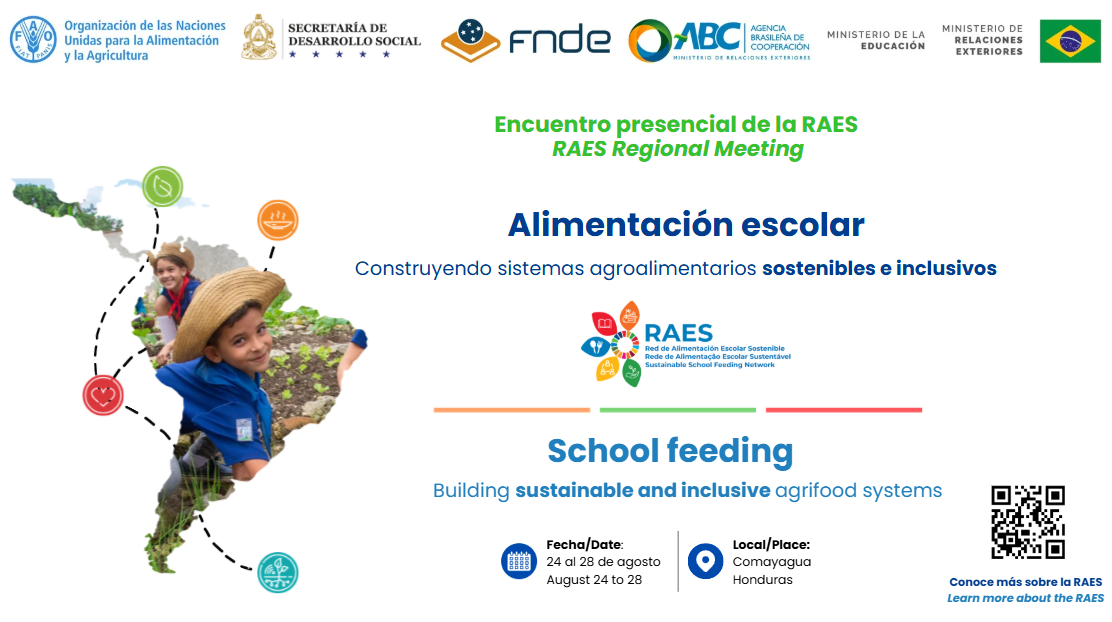
Comayagua, Honduras, 18 August 2026 – In a region where nearly 80 million students have access to school feeding, representatives from 18 countries in Latin America and the Caribbean will meet in Honduras to advance a regional agenda aimed at strengthening school feeding programmes and their contribution to more sustainable and inclusive agrifood systems linked to local production.
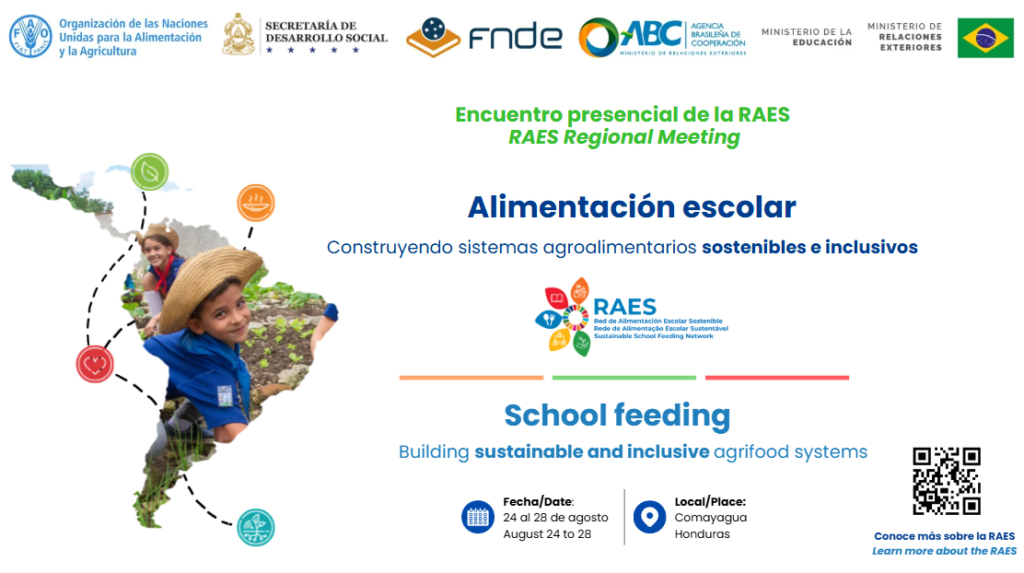
The in-person meeting of the Sustainable School Feeding Network (RAES), “School Feeding: Building Sustainable and Inclusive Agrifood Systems,” will take place from 25 to 28 August in Comayagua. The event is organized by the Food and Agriculture Organization of the United Nations (FAO) and the Government of Brazil, through the Brazilian Cooperation Agency of the Ministry of Foreign Affairs (ABC/MRE) and the National Fund for Education Development (FNDE).
In addition to the RAES meeting, a mission will be held as part of the project “Incorporating aquatic foods from local fishers and aquaculture producers into school feeding programmes in Latin America and the Caribbean.” The initiative brings together Honduras, Belize and Bolivia to promote the incorporation of fish and fisheries and aquaculture products into school feeding programmes, while contributing to the strengthening of local economies and sustainable agrifood systems. The initiative is supported by FAO’s Flexible Voluntary Contributions Mechanism (FVCM) and by the governments of Flanders, Norway, Qatar (Qatar Fund for Development), the Principality of Monaco and Sweden.
Over the course of four days, the international delegation will engage in dialogue and exchange experiences on school feeding policies and programmes, as well as define joint actions to strengthen school feeding in the region in the coming years.
National government authorities are expected to attend the opening ceremony. Other international organizations have also confirmed their participation, including the Global Alliance Against Hunger and Poverty, the Rockefeller Foundation and the School Health and Nutrition Research Consortium.
Fish in school feeding
A topic that will receive particular attention is the inclusion of fish and aquaculture products in school feeding. These foods can help diversify school menus while providing omega-3 fatty acids, vitamins and minerals, as well as high-quality protein.
Another topic to be addressed is the role of rural women in public procurement from family farming, particularly the contribution of institutional markets to improving the incomes of farming families while ensuring the supply of healthy food to students.
School feeding in Honduras
As part of the agenda, the international delegation will learn about Honduras’ experience in implementing its school feeding programme through dialogue with authorities and programme managers responsible for implementation at the national and subnational levels. The objective is to identify lessons learned and practices that may be relevant to other countries.
In 2016, Honduras approved its School Feeding Law to guarantee children attending public educational institutions across the country access to healthy, safe and nutritious meals. The development of the law received support from the Brazil–FAO Trilateral South-South Cooperation, as did the implementation of the Sustainable Schools methodology in the country, which seeks to promote municipalities and schools as models for the implementation of school feeding.